

Much has been said about the illustrious history of defiance of the Filipino
people against foreign imperialists. A number of films have been made to
commemorate the heroism of valiant Pinoys such as Jose Rizal and Andres Bonifacio. They have paid the
price of independence with suffering and eventually with their own life.
But
what is independence for the common Filipino? The war is not always punctuated
with mighty pens and blood-drenched bolos. The war also echoes faint cries of
rebellion and unheard affliction of the oppressed. Raya Martin's latest body of
work, Independencia, brings us back to the time when independence is a noble
but unattainable concept. Instead of portraying the forefront of the war for
freedom, Direk Raya invites us to look at the struggle from another angle.
After reaping accolades for Maicling Pelicula Nang Ysang Indio Nacional (O
Ang Mahabang Kalungkutan ng Katagalugan) and Autohystoria, Raya finds
himself in the world's most prestigious film festival this year. His latest
film, Independencia, competed in the Un Certain Regard section of the Cannes
Film Festival.
Un Certain Regard, which literally translates to "a certain
glance", is a parallel competition to the Palme d'Or (the festival's top plum) that aims to discover young
talents and feature audacious works by extending a financial grant to aid the
winning film's distribution in France. Compared to other movies being screened
in the Cannes Film Festival, the competing works in the Un Certain Regard
section are more experimental and avant-garde in their approach to
filmmaking.
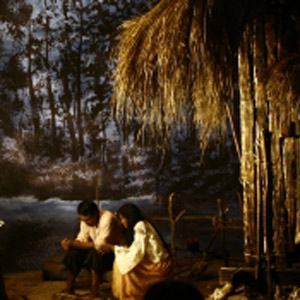
Independencia offers mostly visual fare with an allusive story characterized
by Philippine culture and history. A strong-willed mother (Tetchie
Agbayani) and her son (Sid Lucero) were compelled to leave town to escape from
the sounds of war.
The family's solitary existence was cut short when the son
found an abused woman (Alessandra de Rossi) unconscious in the forest.
Together, they took refuge in a derelict hut and toiled to build a shelter and
a home. In the jungle, they may be free citizens who could do anything they
wish unlike the rest of the population who are at the mercy of the whims of the
American troops. However, their freedom is but artificial. They are confined in
a claustrophobic world akin to a subconscious prison. Moreover, they are
enslaved by their past. The lush tropical forest is unwelcoming. Nature is
raging with fury. And danger is imminent. The family is a portrait of
freedom-loving Filipinos willing to brave the odds just to have a taste of
independence. But they too paid the price.
The look and feel of Independencia follows the same vein as Indio
Nacional: it aims to imitate the cinematic style of a particular period. Since Independencia is set during the early years of the US colonization, Direk Raya shot the entire film in vivid black-and-white inside a studio and reconstructed
a forest setting by dressing it with potted plants, painted backdrops,
simulated rain, flying sparrows, and a flowing river.
The idea is to create a
realistic-looking forest to emphasize the artificiality of the so-called
independence the characters are enjoying. To further imbibe us into the era,
the actors spoke in old-fashioned Tagalog. Their dialogues are teeming with
superstition, sayings, and tales inherited from their ancestors. The cultural
element is so thick (may be to a fault) that it is almost palpable.
Direk Raya's style is not for everyone. Even cinephiles are polarized by his films.
People look at his films as either revolutionary or pretentious. But for those
who are seeking alternative cinema, this visionary filmmaker may pique your
curiosity.
Independencia had its Philippine premiere during the 14th French Film Festival
held at Shangri-la Plaza Mall on the 111th day of Philippine Independence.
It will be screened during the 5th edition of Cinemalaya at the Cultural Center of the Philippines this July. It will also have a limited screening schedules this August.