
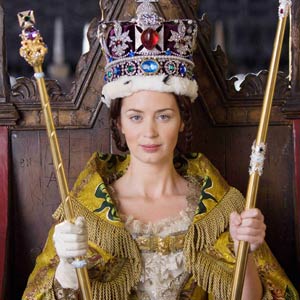

From the Oscar-winning producing team of Martin Scorsese and Graham King (The Departed) comes the soaring drama The Young Victoria which chronicles Queen Victoria's ascension to the throne, focusing on the early turbulent years of her reign and her legendary romance and marriage to Prince Albert.
Starring
Emily Blunt, Rupert Friend, Paul Bettany, Miranda Richardson, Jim
Broadbent and Mark Strong, The Young Victoria will be shown
exclusively at Greenbelt 3 starting September 30.
For Academy Award-winner Julian Fellowes (Gosford Park)
who wrote the screenplay, it was the early life of the young queen that
fascinated him. "Ninety nine percent of the public don't know anything
about the story of her early life and will be surprised."
The
film is set in the period from 1836, the year before Victoria ascended
the throne, to 1840 the year she married Prince Albert and sets out to
revise the widely held picture of Queen Victoria as an elderly widow
dressed in black. "The Queen Victoria everyone knows is the older Widow
of Windsor with the handkerchief on her head, a rather fat woman in
black looking depressed. Very few people know about the other side of
her, her early life: that she was young, that she loved dancing, that
she loved music and that she was very romantic. Some girls like to have
fun and she was certainly one of them," explains Fellowes.
"But the
extraordinary story at the beginning of her reign is how everyone tries
to control her. I was convinced we should begin the film before her
succession and her marriage to Albert. That way you can see her
struggle with her mother, the Duchess of Kent, who tried to devise a
role for herself so she could get more control. The business of instant
celebrity is also interesting," Fellowes continues. "One minute
Victoria was living under virtual house arrest, the next she was the
most famous woman in the world."
The
early part of the film presents Victoria living in a virtual prison.
Fellowes explains Victoria's early life. "Before her 63 year reign
began, Victoria had a horrible childhood. Her father died before her
first birthday, leaving her mother, the Duchess of Kent, to raise the
sole heir to the throne. The Duchess can never have another child who
is in line for the throne because her husband is dead. She's just got
this one frail little squib who will be Queen if only she doesn't die.
This created in her a kind of neurotic protectionism, a smothering
childhood where Victoria could not have her own room and had to sleep
on a little cot next to her mother's bed until she was 18. She wasn't
able to go up or down stairs without holding an adult hand. She had
almost no friends. It was a terribly lonely childhood."
At
the heart of the film is the love story of Victoria and Albert, who she
married in 1840. This happy and fulfilled chapter is the focus of the
film. "Prince Albert was purposefully chosen for Victoria over his less
attractive older brother, by his uncle King Leopold of Belgium,"
explains Fellowes. "Leopold was using Albert to jostle for power and
influence over the British throne and considered him
ideal for a woman who was determined to marry for love. What is
interesting is that Albert fell for her completely. He came from a very
dour German court and suddenly he was with this girl who was out for a
good time. She loved dancing, music, riding. Everyone had overlooked the possibility that they would fall in love with each other."
What
appealed to producer Graham King about the story was the romance. "It
is a pure love story to me. It is a human story, a story that people
can relate to rather than just being a standard period film or film
about royalty. I didn't want it to be a conventional period film, but
something a bit hipper and a bit edgier."