
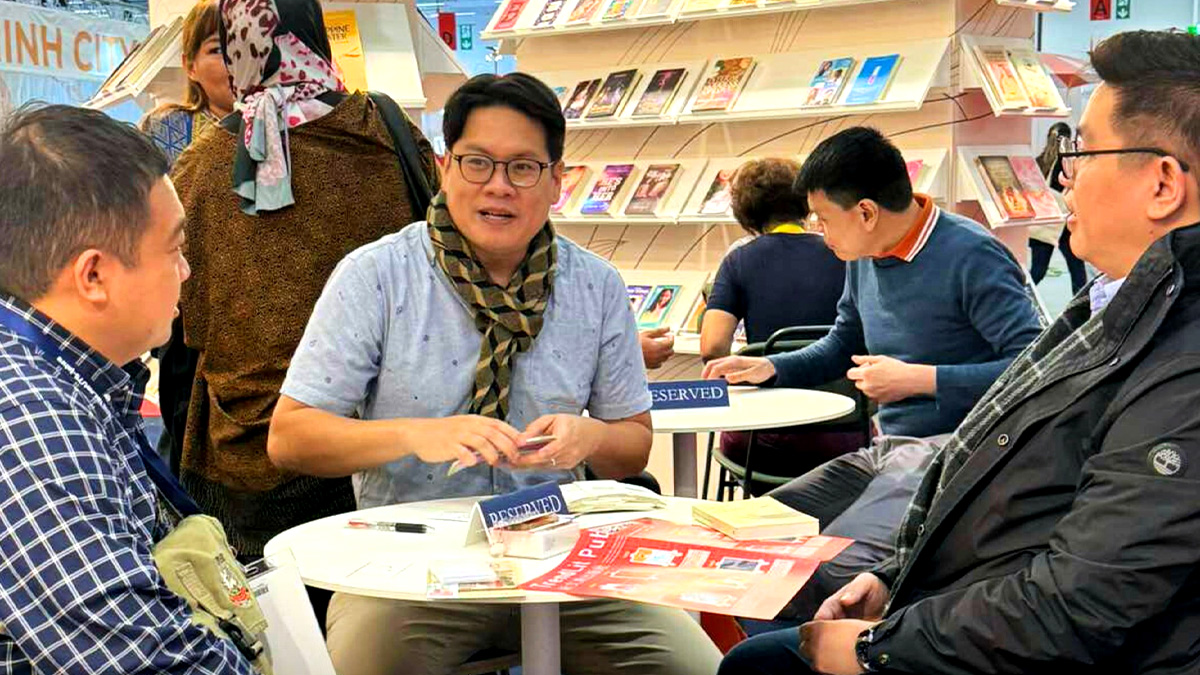

(SPOT.ph) Right before the end of the Frankfurt Book Fair, a Japanese publisher posts a small handwritten sign at the front of its booth in the International Exhibitor stands of Hall 5.1.
The business part of the fair is over, so there are no more editors in suits and scarves standing guard over the splayed-out fan of catalogs, no more animated meetings around the plastic tables. Instead, there is only the sign that reads, "Come inside. Take home any book you want."
Mere steps away from the Japanese stands, I am sitting with other editors in front of the Asia Stage, listening to a panel exchange on the state of Asian comics outside the dominant, all-conquering spheres of superheroes and manga led by Taiwanese editor Aho Huang.
However, Huang isn’t interested in discussing only comics.
Eyes twinkling above the riot of his candy-colored shirt, he grins at the people assembled before him and sums up the business of books with one question: "Publishing… or gambling?"
He gestures up at the wide ceilings of Hall 5.1 while saying, "Of course, this is a nice place. It’s a dreamland. But we have to face it. We are coming for the dream, but we are also coming for the business."
Then, he opens one palm expansively as if beckoning us to join him. “Welcome to the Frankfurt Casino,” he says jokingly.
Also read: The Philippines Is the Guest of Honor at Frankfurt Book Fair 2025
The Frankfurt Book Fair is a massive trade fair of all things books and publishing
The enormity of the Frankfurter Buchmesse, a.k.a. the Frankfurt Book Fair, is staggering.
For eight years—not counting the depressing, terrifying pandemic era—I helped man a booth at the Manila International Book Fair at the SMX Convention Center as part of my day job at Summit Books, SPOT.ph's sister title under Summit Media.
I knew the swell and the crush of a book fair intimately.
But Frankfurt is the size of many, many MIBFs. Each of its six halls is possibly equivalent to one SMX in itself.
To move from one hall to another is to double or triple your daily step goals if you're the type who keeps track.
I am not one of those people. Instead, I am the guy rubbing his sore feet after the end of one particularly long day, deeply regretting walking around the Buchmesse in formal leather shoes.
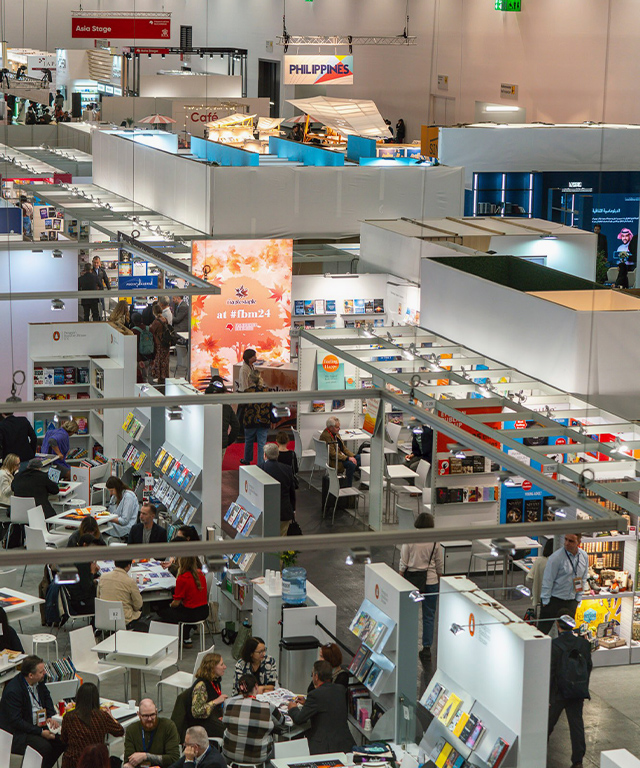
The fair runs for five days, with the first three devoted solely to the trade—authors, creators, publishers, editors, agents, and the like working around the clock to network and collaborate.
Only on Saturday and Sunday is the fair opened to “private visitors,” the Buchmesse euphemism for the book-buying public.
a publisher exploring the Frankfurt Book Fair as a "private visitor"
On Saturday, I walk around the fiction, young adult, and new adult halls—this time in sneakers.
It was a book fair that seemed different yet familiar.
Ads for books and book-adjacent finds flash on giant LED screens and tarps or posters—Yuval Noah Harari’s Nexus, Al Pacino’s memoir Sonny Boy, Kelly Barnhill’s When Women Were Dragons, a new Princeton University cover for Karl Marx’s Capital, a row of standalone screens shilling for audiobooks on Spotify (“No page turning required”), a shapeshifter fantasy novel-turned-German movie called Woodwalkers.
But amidst all these ads clad in Buchmesse’s inescapable police tape-style branding is FBM 2024's "read!ng" tagline—with the deliberate ! in the spelling. Meanwhile, I keep on walk!ng.
Inside the new adult grounds, almost every booth is packed. Readers snake across the hall floor in unrelenting lines.
The publishers are doing things I’d never seen back home, like spray-painted edges or tin subscription boxes, and it all seemed to be working. This hall was drawing in the crowds.
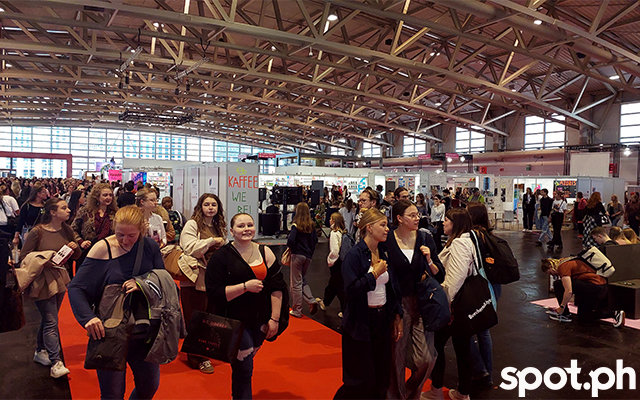
This is the first year new adult fiction has its own Buchmesse hall. And that’s the reason, I suppose, why I was in Frankfurt in the first place.
For a decade and more, our imprints of Pop Fiction and Cloak have made Tagalog new adult their stock in trade—hundreds and hundreds of romances, thrillers, fantasies, and even that wonderful portmanteau "romantasies," the new crowd-favorite mix of romance and fantasy novels.
The National Book Development Board (NBDB) invited Summit Books and other new adult publishers to fly into Germany from October 14 to 21, to see if there was a space—and hunger—for Philippine romance inside the biggest book fair in the world.
PHOTO BY
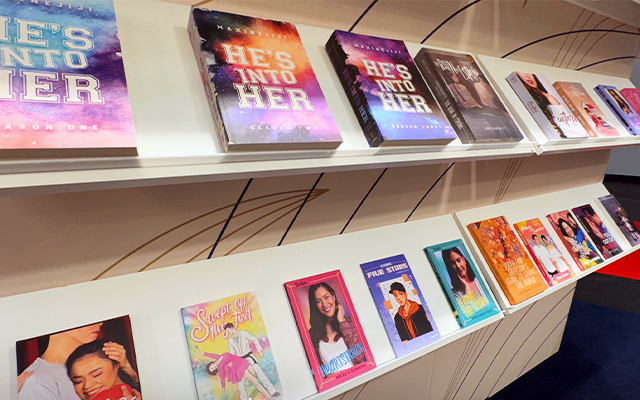
“I feel people read us not because our love stories are set in the Philippines, but because they’re love stories,” says Mina Esguerra at a talk she gave at the New Adult Hall.
Esguerra is a longtime novelist and founder of #RomanceClass, an organization of independently published Filipino writers.
She’s been thinking about romance for a very long time. “I feel safe reading my favorite romances, and I think that’s what a lot of readers feel. With romances, we know exactly what we’re getting.”
Her moderator, bearded and in plaid, nods. Romance is indeed a safe, warm blanket.
Inside our stand, a few curious German readers trickle in and out, asking which books are in English and whispering among themselves as they flip through the pages.
One of them amazingly tells us that she knows about Philippine love teams: KathNiel, JaDine, and LizQuen. We didn't have the heart to tell her that all those pairings were no more.

The Philippine stand lies just across the front door, hemmed on all sides by romantasies.
Amid the steel-edged typographic titles with their deep ebon, purple, and gold, I’d like to think that Philippine romance novels—all winking covers and playful colors—stand out.
In my mind, it’s a little like when breakdancing got accepted to the Olympics. You can only pray that you don’t pull a Raygun.
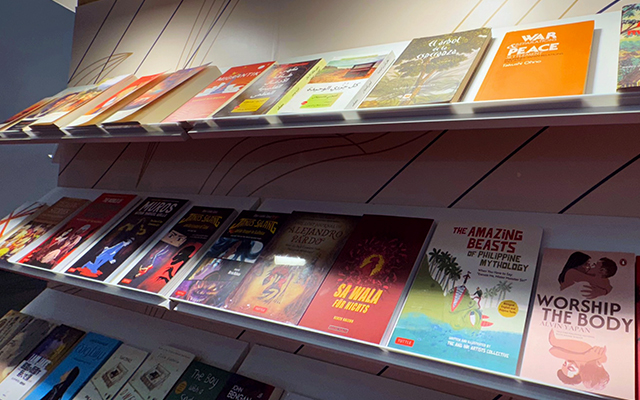
Publishing is still a numbers game after all
As I continue my adventure around Frankfurter Buchmesse, it hits me, albeit not for the first time, that the romantic image of our book-loving imagination—the private communion between an author madly conjuring lines and a reader curling up on a rainy day with their book—is mediated from all angles by massive industry.
It has always been like this. I’m not naive. I work in books. But it is only in Frankfurt that I see how big the teeth on those gears are.
It was in the "Young and Indie Publishers in Asia" panel that I fully realized the odds were not equally stacked among the stands.
“India has about 1.4 billion people. The entire size of the publishing market in India is nine billion dollars,” says Prashant Pathak, who used to be an independent publisher in India before moving to work for the English language department of an Italian press.
“But here’s the interesting part: Only four percent of this 9 billion read for leisure. So the trade market”—industry lingo for the books you and I are most familiar with, the ones we can find in bookstores—“the entire trade market in India is actually smaller than one of the biggest companies in Germany,” Pathak laments.
Still, as an indie publisher in India, the sheer scale meant that he regularly sold titles in tens or hundreds of thousands of units.
These sales numbers are staggering, especially for the Philippines, where Miriam Defensor-Santiago’s 110,000 copies for Stupid is Forever already seems like an insurmountable high-water mark for the trades.
Even the panel’s moderator, Sarge Lacuesta—a writer and an indie publisher himself—seems floored by Prashant’s figures. “This has become a conversation about markets.”
But why do we continue to publish, or more importantly, why do people read?
During the first few days of the Frankfurt Book Fair, business cards are laid on tables. Risks are weighed. Bets are made, bets are hedged—the Frankfurt Casino realized.
Seriously though, trends are studied, or dissected and coated with liberal amounts of gloss.
Books are compacted into cover thumbnails and log lines, and entire libraries are compressed into catalogs.
The dealer—a publisher— drums his fingers on the table; you reveal your hand. “Here’s a story we made. Don’t you think somewhere out there in the world, someone wants to read it?”
In a panel about Patricia Evangelista's runaway bestseller, Some People Need Killing, the author reads a passage from the book and talks about how tough it was to make it.
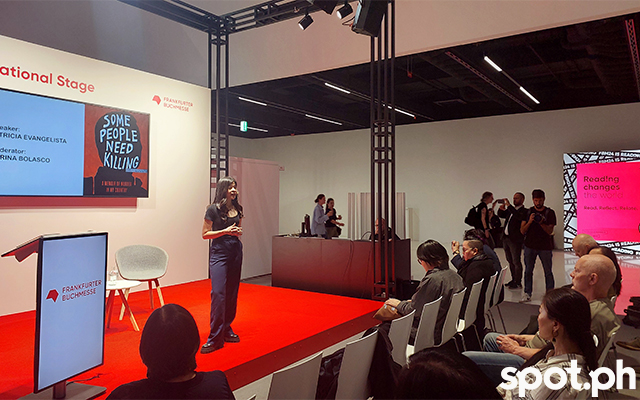
Later in the panel, someone asked her how she unwinds. Evangelista beamed. “I read a lot of romantasy,” the journalist reveals. “I don’t read books with sad endings. I operate in a universe where bad things happen, so I am grateful for literature to give me a way out.”
As I fly back to the Philippines, I read Jeanette Winterson’s memoir, Why Be Happy When You Could Be Normal? I didn’t pick it up from Germany; I brought it with me.
In the book, Winterson discovers that words on a page can wrestle meaning out of difficult lives, and this is also their terrifying power.
In one passage, Winterson talks about To His Coy Mistress, published in 1681 after the death of its author, Andrew Marvell. It is, Winterson says, "one of the most wonderful poems in English." Two lines go:
Thus, though we cannot make our sun
Stand still, yet we will make him run.
“Read it aloud,” exhorts Winterson. “And look what Marvell makes happen by putting the line break at ‘sun.’ The line break right there forces a nano-pause, and so the sun does indeed stand still—then the line gallops forward.”
Beside me, a fellow passenger cracks the window open. It is a long, seventeen-hour flight, and we have suffered most of it in the darkness. Immediately, a shaft of light blazes in—the sun, still, ever and ever east.
(Lio Mangubat is the editor-in-chief of Summit Books. He is the author of "Silk, Silver, Spices, Slaves," published in 2024 by Faction Press in Singapore. He also created the Philippine history podcast "The Colonial Dept.," on which his book is based.)
This article is originally published in SPOT.ph. Minor edits have been made by PEP editorial.