
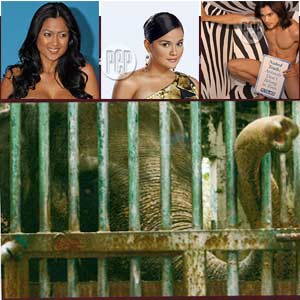

For the past three years now, PEP (Philippine Entertainment Portal) has featured the campaigns of PETA (People for the Ethical Treatment of Animals), the largest animal rights organization in the world that has over two million members and supporters.
Remember the "Go Vegetarian"campaign of Yasmien Kurdi? How about the bare-it-all pictorial of Diether Ocampo to underscore “Naked Truth: Animals Don’t Belong in Zoos"? Of course, you surely didn't miss the anti-captivity ad of Borgy Manotoc and Ornusa Cadness where their bodies were painted with tiger stripes.
This time, the spotlight is on Mali, who has a celebrity status in Manila Zoo.
WHO IS MALI? Vishwamali, or Mali for short, is an elephant who was born in Sri Lanka in 1974. She was only three years old when she was torn from her family and shipped to the Manila Zoo.
Confined to a barren, concrete enclosure where she lives alone, Mali is now said to be exhibiting the classic signs of depression and psychological stress. Bringing more elephants to the zoo will increase profits, but not further the wellbeing of Mali. The Manila Zoo's decrepit enclosure cannot adequately house one elephant, let alone more than one.
Hence, PETA is calling on the zoo's administrators to immediately relocate Mali to an accredited sanctuary, where she can enjoy the vital companionship of other elephants and roam and forage amid lush, natural vegetation.
In the wild, elephants such as Mali live and travel in close-knit matriarchal herds of related females, who roam up to 80 kilometers a day. Asian elephants have home ranges of between 25,000 and 60,000 hectares. The entire Manila Zoo measures only 5.5 hectares.
PETA's investigation revealed that when she's not on display, Mali spends most of her time sleeping. In the wild, Mali can browse and graze; pluck fruit, leaves, and shoots from trees; take mud baths and swim and play in the water.
Carol Buckley—who has more than 35 years of professional experience in the care and management of Asian elephants and who operates The Elephant Sanctuary, which, at more than 1,000 hectares, is the largest rehabilitation and living center for former zoo and circus elephants—told PETA:
"There can be no doubt that Mali's undersized living space and isolation has had, and will continue to have, a severe negative impact on her physical and psychological health. More often than not, captive elephants are afflicted with painful and crippling illnesses that are directly related to lack of space and lead to drastically shortened life spans. It is likely that Mali is or will ultimately be afflicted with muscular-skeletal ailments, arthritis, and/or foot and joint diseases."
Buckley has offered to accept Mali at The Elephant Sanctuary. Thailand's Elephant Nature Park would be another alternative home for Mali.
Mali—like all elephants who are confined alone and denied everything that's natural and important to them—is also suffering psychologically. The frustrations that captive elephants endure often lead to abnormal, neurotic, and even self-destructive behavior called "zoochosis" or "stereotypy." As an example, Mali paces incessantly and has been observed standing in one spot with her trunk to the ground. She has also been seen walking to the edge of her tiny enclosure and reaching out her foot in the futile hope of going farther.
A growing number of progressive zoos—including several in the U.S. and U.K.—have realized that they cannot possibly provide for the complex needs of elephants and have closed their elephant exhibits. Government officials in India recently mandated that elephants should be in sanctuaries because zoos cannot adequately care for them.
According to David Hancocks, former director of the Woodland Park Zoo in Seattle, Washington, "[Elephants] are actually very poor candidates for life in captivity....Their requirements are so substantial — it is probably beyond the capabilities of most zoos to even begin to resolve them."
Likewise, PETA Asia-Pacific Director Jason Baker said, "Elephants in zoos everywhere suffer, but Mali's situation in the Manila Zoo is one of the worst cases in the world. Instead of forcing her to live in misery and even face an early death, the Manila Zoo should immediately send Mali to a sanctuary where she can be with other elephants and live out her life in peace, health, and dignity."
PETA's complete report in PETAAsiaPacific.com.