



UNICEF goodwill ambassador Anne Curtis used a series of retweets to remind the public about having themselves protected against polio disease.
It came on the heels of the Department of Health's (DOH) announcement on Thursday, September 19, confirming the resurgence of polio disease in the country—which has been polio-free since 2000.
Anne’s first tweet read: “Please take time to read (broken heart emoji).” The post was about UNICEF declaring support for DOH’s “outbreak response.”
Please take time to readhttps://t.co/j90XuS3BLE
— Anne Curtis-Smith (@annecurtissmith) September 19, 2019
After a few hours, Anne shared an article from DOH’s website, announcing the health agency’s plan to launch a mass immunization campaign against the infectious disease.
The government’s health arm also stated: “Poliovirus also detected in the sewage and waterways of Manila and Davao.”
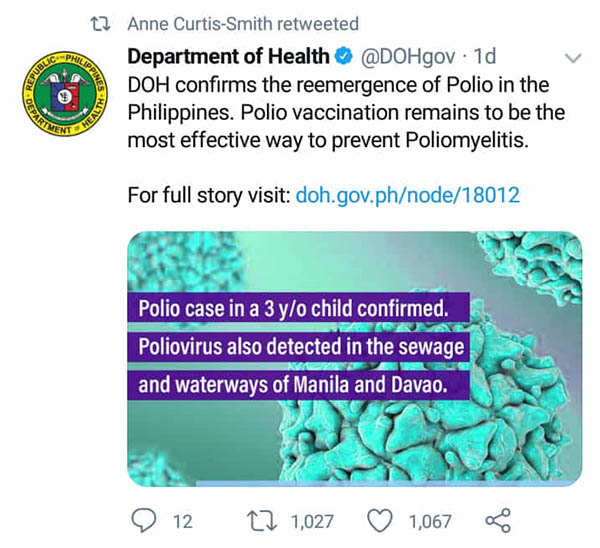
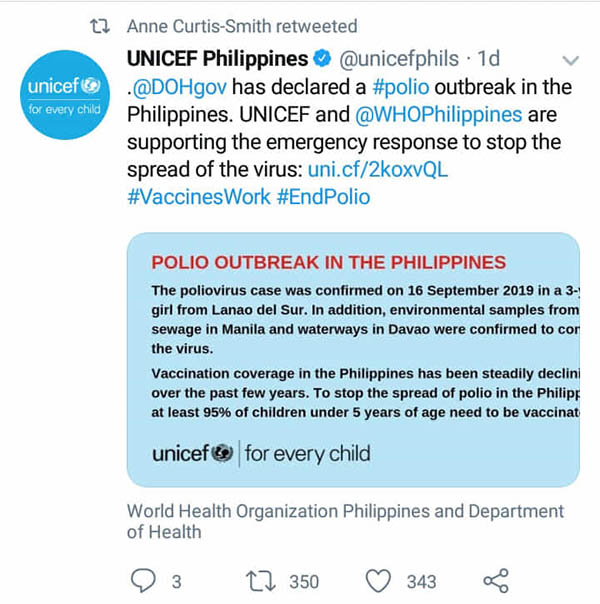
Anne also retweeted the same announcement from UNICEF Philippines using the hashtags #VaccinesWork and #EndPolio.
In Anne’s last tweet, she appealed to her 11.8 million followers to “protect yourself and loved ones from Polio” by “completing polio vaccination and ensuring proper sanitation and hygiene practices.”
Protect yourself and loved ones from Polio by taking these precautions
— Anne Curtis-Smith (@annecurtissmith) September 19, 2019
DOH DECLARES POLIO EPIDEMIC
Health Secretary Francisco Duque explained to members of the media that one positive case of the disease was enough to declare an “epidemic” in a polio-free country.
A three-year old girl from Lanao del Sur tested positive of the poliovirus on September 16.
The Philippines has been declared polio-free by the World Health Organization (WHO) since 19 years ago.
On September 20, DOH confirmed another case in Laguna. The patient is a five-year-old boy.
POLIO CAN BE FATAL
Polio is an infectious disease that spreads rapidly and mainly affects children under five years old, according to DOH.
The poliovirus can be transmitted through direct contact with someone infected with the virus, particularly through their feces, or less commonly, through contaminated food and water.
Based on WHO’s fact-sheet, while polio normally causes paralysis, it can also be potentially deadly when the muscles used for breathing gets immobilized.
The symptoms include fever, headache, fatigue, sore throat, vomiting, arm and leg stiffness, and muscle tenderness and spasms.
The DOH said there is no cure for polio, and can only be prevented with multiple doses of polio vaccines that have long been proven safe and effective.
It also cited low vaccination coverage, poor early surveillance of symptoms, and substandard sanitation practices as culprits in the re-emergence of polio.