
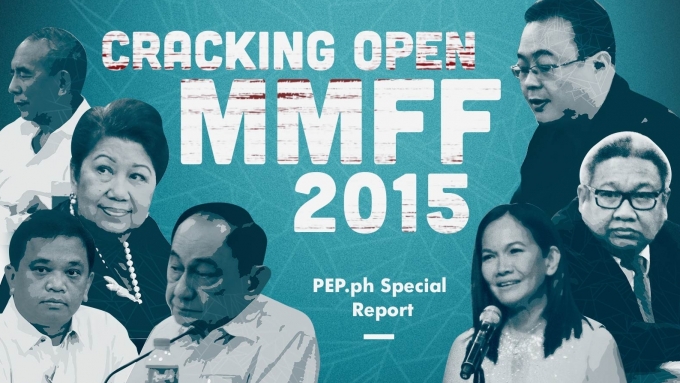

The 2015 Metro Manila Film Festival raked in the most money (P1.01 billion compared to P439 million in 2009), but also generated more heat than usual (last-minute disqualification of Honor Thy Father from best-picture race).
The film’s director, Erik Matti, posted angry messages on Facebook and angrier tweets on Twitter. Film-industry insiders also expressed dismay over HTF's disqualification. Moviegoing netizens took notice and reposted these, eventually turning these sentiments viral and elevating the issue to a scandal.
Laguna Representative Dan Fernandez called for a congressional probe of the 2015 MMFF. Here, "conflict of interest" was raised as an issue. Indeed, it played a central role in the scandal. But, if strictly applied, "conflict of interest" tainted all key players in the scandal, including the very parties who made it an issue.
The congressional meetings, held on January 11 and 13, 2016, and February 18, 2016, led to changes in the yearly film festival. These included the revamp of the powerful MMFF Executive Committee and the formation of a Technical Working Group to draw up rules and regulations for MMFF 2016.
Among the new rules for 2016, the most controversial is the rule requiring all producers to submit completed films to the festival's Screening Committee. In all previous festivals, only completed scripts were required.
Based on the minutes of three congressional meetings and on independent interviews with key industry players, the Philippine Entertainment Portal (PEP.ph) runs down the MMFF 2015 issues, in brief:
DATE OF APPLICATION. Honor Thy Father producer Ronald "Dondon" Monteverde said he applied to join the MMFF on June 8, 2015. On June 21, the MMFF announced the eight official entries, and HTF, which ranked ninth, did not make it.
Dondon claimed that the MMFF Execom “invited” HTF to join the MMFF roughly four months later, on October 21. On October 22, Dondon responded positively, and sent the MMFF Execom a signed Certificate of Compliance, effectively saying he was in conformity with all festival rules. One of these rules said that any film joining the festival cannot be shown in any venue other than the MMFF.
On November 3, two MMFF subcommittees discovered that HTF was scheduled to open Cinema One Originals, an ABS-CBN film festival, on November 8, 2015. MMFF Execom Chairman Jesse Ejercito said that Monteverde's failure to disclose this in his October 22 letter was a violation of MMFF 2015's rules.
Producer Dondon, ignoring the issue engendered by his film being in Cinema One Originals, pointed instead to his June 8 letter, saying that this carried with it a signed Certificate of Compliance.
REALITY ENTERTAINMENT’S NONDISCLOSURE VIOLATION. Monteverde and Honor Thy Father director Erik Matti contended that, after HTF was excluded from the Magic 8 on June 21, they began searching for other festivals to exhibit Honor Thy Father in. In September, they showed HTF at the Toronto International Film Festival.
MMFF Execom Chairman Jesse Ejercito argued, however, that on October 21 the MMFF Execom had sent Reality Entertainment a letter saying that the movie Hermano Puli had pulled out of the festival, and that HTF “may be considered as the replacement entry, as they are next in rank.”
Ejercito pointed out that, by October 21, Reality Entertainment should not have entered Honor Thy Father, even as a non-competing opening film, in the Cinema One Originals—a film festival outside the MMFF 2015 and set for November of the same year.
MMFF Execom member Dominic Du added, “They answered back on October 22 saying that they have complied, without mentioning anything about Cinema One Originals festival, which, we are very sure, by that time alam na nila [na papasok sila dun.]”
Dondon countered that this was not a violation of MMFF rules because tickets were not sold and that the event was “by invitation only.” He added that they informed the MMFF Execom a few days before Cinema One Originals opened.
Despite the urgency of the issue, the MMFF Execom failed, from November 6 to December 14, to discuss the nondisclosure violation. Explaining itself, the Execom said that the MMFF was then in the middle of a major transition in its leadership. On October 7, Francis Tolentino, who signified his desire to run for the senate, resigned as chairman of the Metro Manila Development Authority (MMDA) and the MMFF. (Presidential Proclamation 1647 makes the chair of the MMDA automatically the chair of the MMFF.)
In addition, explained the Execom, during the period of November 18-19, the Asia Pacific Economic Cooperation (APEC) was held in the country, and the MMDA was charged with facilitating the smooth traffic flow for the international delegates.
PROCEDURAL LAPSE. On December 14, two MMFF committees—the Rules Committee and Special Working Committee—decided to disqualify HTF from the best-picture category. They said they limited the film's disqualification only from that category: (a) in order to penalize only the film's producer; and (b) to give the cast and crew a chance to win awards in other categories.
In other words, Execom member Marichu Maceda said, they did this out of compassion for the artists and technical personnel involved in the film.
Producer Monteverde countered that the decision to disqualify HTF should have been made by the MMFF Execom, not the subcommittees, which were represented in the Lower House Metro Manila Development committee meeting by Marichu Maceda and Dominic Du.
DOMINIC DU AND MARICHU MACEDA MEET WITH JURORS. Maceda and Du met with festival jurors on December 21. At the time, the jurors had just finished screening all entries and were about to start deliberations.
Maceda said she deemed it right that the jurors be informed of Reality Entertainment’s nondisclosure violation, although she was aware that the final decision on the penalty was up to the MMFF Execom, which would not meet until December 26.
From the December 21 meeting there emerged two conflicting stories: Juror Carmen Musngi claimed that Maceda and Du told them that HTF had been disqualified from the best-picture category. Maceda and Du disputed this, claiming they merely informed the jurors about the nondisclosure violation of HTF, which opened the film to disqualification.
Chairman of the Board of Jurors Rowena Capulong-Reyes, for her part, said she asked the jurors to vote on whether or not HTF should be disqualified from the best-picture category. Reyes claimed “80 percent” voted in favor of HTF’s disqualification from that category. Musngi and fellow jurors Paul Resurrecion and Lawrence Javier disputed this. They said they could not remember any formal voting among the jurors.
Maceda admitted that Professor Reyes did not explain the nondisclosure issue to the jurors on the first, second, or third day of the screening, but that Reyes did so just before their deliberations began. “Our reason was that we did not want to pollute the minds of the jury about the disqualification,” Reyes said, “because we wanted them to judge freely as far as the other awards were concerned.”
Musngi and another juror, Arnold Vegafria, said they told Maceda and Du to inform HTF's producers about the disqualification.
SHORT NOTICE OF DISQUALIFICATION. Monteverde was incensed. He said the two subcommittees made the decision to disqualify HTF as early as December 14, yet Reality Entertainment was informed only on December 26, or 12 days after, and less than a day before the MMFF Awards night set for December 27.
“We were not given the courtesy of due process when HTF was disqualified in the best picture category,” the producer smarted.
Based on MMFF rules, a producer had 10 days to file a formal complaint against a decision.
MMFF Overall Chairman Carlos disclosed that he learned about HTF’s nondisclosure violation only on December 25, and immediately called for an emergency meeting on December 26. He agreed that the two subcommittees should have informed him earlier about this “vital issue.” But, he said, he was backing the decision to disqualify HTF, making the decision unanimous.
Maceda later admitted that HTF should have been disqualified much earlier from all categories: “Looking back, I think we should have disqualified it totally from the very start.”
HTF’S PARTICIPATION IN ANOTHER FESTIVAL. The MMFF Execom accused Reality Entertainment of also failing to disclose that it exhibited HTF at the Hawaii International Film Festival on November 14 and 18, 2015.
But Monteverde argued again that he submitted a Certificate of Compliance with his June 8 letter, when his camp first applied applied to MMFF. Moreover, he argued, if HTF was supposed to be disqualified based on the nondisclosure of participation in Cinema One Originals, why was the MMFF bringing up the Hawaii film festival? “Huwag na tayong mag-dwell dun sa iba, just the facts,” Monteverde said, piqued.
Chairman Carlos did not find Monteverde's argument sound. He countered: “At the time na ni-receive namin ang application, there was already an acceptance, there was already a promise on your part, that you will not join any other festival. Otherwise, had you so stated, we could have picked another. We could have advised you.”
The MMFF subcommittees said they also discovered later that tickets were sold in both the Toronto and Hawaii film festivals, constituting another violation, this time of the MMFF rule prohibiting entries from commercially exhibiting locally or abroad.
DISQUALIFYING HTF FROM THE BEST-PICTURE CATEGORY AFFECTED ITS BOX OFFICE POTENTIAL. According to Monteverde, when a film won best picture, it stood to earn more at the box office.
Maceda disagreed, citing examples: “For the record, winning the best picture is no guarantee that it will translate into a box-office [hit]. In our experience in the past five years, nanalo ang Asiong Salonga [2011], Best Picture, did it improve [at the box office]? No.
“Nanalo ang 10,000 hours [2013], starring Robin Padilla, directed by Bb. Joyce Bernal. Did it improve? No.
"Nanalo ang Bonifacio [2014]. It was a beautiful movie. But did it improve in the box office? No.”
ONE–DAY-LAST-DAY PRACTICE. Reality Entertainment had another complaint, this time about Dominic Du, the chairman of the Sales and Playdate Monitoring Committee of MMFF 2015. Monteverde alleged that if a movie had low sales on its first day, it was quickly replaced by Du with a commercial movie the next day.
Du denied that this was his doing, explaining that there was a strict process followed when pulling out a film and replacing it with another. This process began with a written request from the theater owner (or representative) addressed to the Sales and Playdate Monitoring Committee to change the film. This was followed by the theater owner (or representative) and the producer (or representative), with Committee chair Du, signing a document of “conformity.” Only then, Du said, was the change finally effected.
CONFLICT OF INTEREST. Monteverde also took issue with Quantum Films producer Atty. Josabeth “Joji” Alonso, whom he accused of using her connection to Dominic Du, to: (a) disqualify HTF from the best-picture category; and (b) get more theater bookings for her films #WalangForever and Buy Now Die Later.
Aside from holding the post of chair of the Sales and Playdate Monitoring Committee, Du held two other positions in the 2015 MMFF. He was a Selection Committee member and the Rules Committee vice-chairman. Outside the MMFF, Du is president of the Motion Picture Anti Film Piracy Council (MPAFPC) and booking coordinator for the National Cinema Association of The Philippines (NCAP).
Interestingly, while Du is president of the anti-piracy council, the latter’s chairman of the board is Dondon’s father, Leonardo "Remy" Monteverde.
Joji Alonso did not deny that she is currently the lawyer of the Motion Picture Anti Film Piracy Council. This, she said, constituted her whole association with Du and, it could be said, with Dondon's father.
She also pointed out that if Du was supposed to be her partner and was charged with ensuring that her films had strong theater booking, then he failed, she said. Buy Now Die Later, according to the lawyer-producer, was shown in “only 18 theaters” and grossed “a mere P20 million.”
For her part, MMFF’s Maceda pointed out that since Dondon brought up the issue of conflict of interest, then he also had to account for his association with Laguna Representative Dan Fernandez. The latter initiated the congressional probe, but he was also in the cast of HTF. “Where’s his delicadeza?” Maceda asked.
ALLEGED PARTNERSHIP BETWEEN ATTY. JOJI ALONSO AND DOMINIC DU. At the congressional probe, Representative Fernandez presented evidence to show the connection between the lawyer and the booker. The first was a legal letter, dated April 10, 2014, written by Atty. Joji on behalf of her “client,” Dominic Du, addressed to the Film Academy of the Philippines (FAP) Director General Leo Martinez.
The FAP had sued the MMFF, which included Du as chair of the booking committee. The FAP had mistakenly assumed that Du headed NCAP; in fact, Du held the position of booking coordinator of NCAP. The letter was a FAP complaint against the MMFF for alleged non-remittance of festival proceeds. Atty. Alonso said her legal letter was written on behalf of the NCAP and Du.
The second evidence that Representative Fernandez presented were screenshots of Facebook posts of Axinite, a company co-owned by Du, which promoted Atty. Joji’s films #WalangForever and Buy Now Die Later. Since other MMFF entries were not promoted in Axinite’s Facebook, concluded Fernandez, Du was the “distributor” of Atty. Alonso’s films.
Du denied the lawmaker’s accusation, saying that Axinite distributed only foreign films. Also, he categorically denied funding Atty. Alonso's films. However, he had no explanation for Atty. Alonso’s films finding their way to Axinite’s Facebook account.
Atty. Alonso confirmed with PEP that Dominic did not fund her films, revealing that her major investor was businessman Fernando Ortigas.
REALITY ENTERTAINMENT’S LINKS TO MMFF EXECOM. While the congressional meetings sought to prove “conflict of interest” in the association between Atty. Joji Alonso and Dominic Du, they turned a blind eye to the same “conflict of interest” involving Dondon Monteverde and MMFF Execom member Marcus Ng.
Marcus Ng is a partner in Post Manila, a post-production company owned by Dondon Monteverde; and Ng Meng Tam, the father of Marcus, is an incorporator and shareholder at Regal Entertainment, a company owned by Dondon’s mother, Lily Monteverde, and in which Dondon has major shares.
Also buried in the 2015 MMFF brouhaha is that Regal Films and Reality Entertainment have had a long-standing relationship with the MMFF. Ng Meng Tam was an MMFF Execom member for many years, while his son Marcus has been a member of the MMFF Execom since 2006 up to the present and was also a member of 2015 MMFF Selection Committee.
MMFF RULES KEEP CHANGING. In 2004, producer Atty. Joji submitted the movie Minsan Pa to the MMFF, but her film did not make it to the eight official entries. She complained to the MMFF Execom, which had allowed Regal Films to submit four films, despite the MMFF ruling that year that every film company could submit only two entries.
Atty. Alonso said a group composed of Ric Camaligan, Wilson Tieng, Dominic Du, and two others convinced her not to push through with her complaints against the MMFF. Coincidentally, Tieng and Camaligan were jurors in the 2004 MMFF.
“At the time, at the back of my mind,” Atty. Alonso narrated to PEP, “there’s a mafia here somewhere.” She said she decided not to pursue her complaint because this would have resulted in the cancellation of the 2004 MMFF and the showing of foreign films during the lucrative Christmas season. “I would not do that. I would not allow myself to be used by any foreign distribution company to stop the MMFF,” she added.
Learning from the experience, the MMFF the next year set no limit to the number of entries a film outfit could submit.
Dondon Monteverde, for his part, bolstered his argument against the MMFF by citing the example of Brillante Mendoza’s Thy Womb. The film had been exhibited in international festivals before it became an official 2012 MMFF entry. At the time, Star Cinema’s Malou Santos protested to the MMFF Execom, but nothing came of her complaint. In 2012, the MMFF rules did not exclude films already exhibited in other film fests. Monteverde pointed out that Wilson Tieng, head of Solar Entertainment and distributor of Thy Womb, was in the MMFF Execom.
In other words, he complained, MMFF changed its rules all the time.
Atty. Joji Alonso, short of naming names, said that she became a target because she was seen as a threat. “This did not come from me. This came from indie filmmakers,” she said. “They said [I was hit] because…I am considered a threat, and I am destroying the balance.”
Quantum Films, Atty. Joji's film production company, is relatively young at 12 years, but has been carving for itself a reputation for producing quality films, on modest budgets, that earn at the box office.
She said the big industry players did not like that.
READ FULL REPORT: PEP SPECIAL REPORT: The Controversy That Opened Pandora's Box