

There is not much in the way of documentary evidence to make Apolinario de la Cruz or Hermano Puli pervasive in the consciousness of Filipinos.
He is mentioned in elementary or high school history classes, but not much beyond that.
In his native Tayabas (now Quezon) province, Puli is considered a hero.
Director Gil Portes, who himself hails from the same province, admitted that Ang Hapis at Himagsik ni Hermano Puli is a passion project that has been begging to be fulfilled since 1995.
The story narrates the life of an aspiring priest, Puli, who is unable to fulfill his dream because in Spanish-occupied Filipinas (1800s), indios were not allowed into Catholic religious orders. Yet Puli so loved the catechism of the Catholic church that he put up a cofradia or confraternity called the Cofradia de San Jose in Tayabas.
However, as the membership grows, the Spanish authorities and friars fear insurrection.
For the first half of the movie, Aljur Abrenica, who plays the titular role, seems to only alternate from cocky to happy to confused. That is not to say that he does not register the appropriate expressions for specific scenes, but it is only when the time comes when he needs to inspire and lead the members of the cofradia to actively resist and make a stand against the oppressive Spanish forces does he start to display a strong and emotionally layered performance.
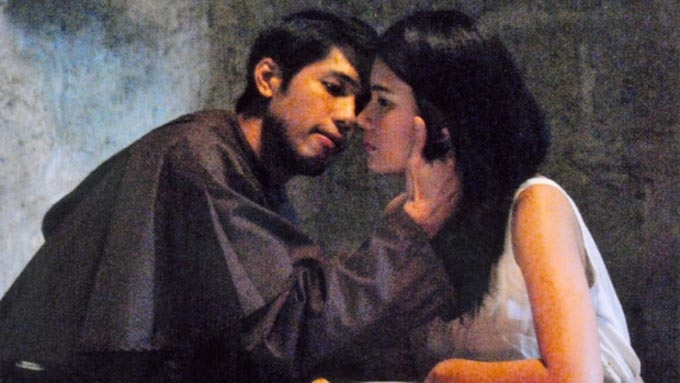
Prior to that, his most passionate and authentic scene is in close quarters with Louise delos Reyes as Hermana Lina, whose devotion to him leads to romantic and carnal feelings.
Louise is beautiful in her innocent adulation that turns to more intense feelings for Puli. She is quietly vulnerable and, in some scenes, heartbreaking as a woman whose feelings cannot be consummated.
Dusky Vin Abrenica and mestizo Enzo Pineda, who play important “hermanos” in the same organization led by Pule, prove that they are not only handsome and brawny, but also can essay themselves well in high conflict scenes.
Vin carries the weight of a great heartbreak throughout his scenes, so that when the backstory is revealed, it reveals another facet of his character.
Enzo has some stilted lines but overall is a strong character that audiences will empathize with.
Markki Stroem, as Colonel Juet, who is well known in the theater scene, has the tendency to “act big” in some scenes—which is more noticeable when he is sharing the scene with television and movie actors.
Elora Espano and Sue Prado prove that there are no small roles. They pack their handful of scenes with so much emotion that they make a lasting impression and become important characters despite their short onscreen presence.
The musical score is haunting, fitting, and very touching. In some cases, the scenes anchored on the music to drive the wave of emotion associated with it. Musical scorers Tonton Africa and Francis de Veyra and sound engineer John Wong deserve to be lauded for this. Not surprising, the editing by George Jarlego is crisp and on-point.
The production design is exceptional, with details meticulously added to spaces that would otherwise be wanting in character. Production designer Arthur Nicdao managed to dress up scenes—some of which relied on computer-generated imagery—with elements representative of the time.
The last sequence includes a reference to current events—making the connection between the Philippines’ past and present, that seem to only be repeating itself with only the actors changing.
Director Gil Portes has put together a strong team behind and in front of the camera. With screenwriter Eric Ramos and consultant Prof. Rhina Boncocan, he has produced a thought-provoking story from scant historical documents and anecdotes or traditions passed down through generations. The hope is that it will increase the consciousness and critical thinking of Filipinos of all ages.
Ang Hapis at Himagsik ni Hermano Puli is now being screened in cinemas nationwide.