


With so much talk surrounding the pros and cons of artificial intelligence lately, a development has come to remind us that we don't need technology to pass off another's work as our own.
See this case of a professor of English Language and Literature.
Riceli C. Mendoza is a former faculty member at the University of Southern Mindanao (USM) in Cotabato.
She has issued a public apology for plagiarizing the thesis of her advisee, Jemima M. Atok, a graduate of AB English.
The apology was posted on Facebook by the USM's Department of English Language and Literature on May 6, 2024.
What happened exactly is unclear, only that Mendoza is a professor at the department and attempted to submit Atok's work as her own.
Mendoza has since acknowledged the "emotional pain" she has caused Atok and her family.
Part of her apology reads: "I am very sorry to publish your thesis in my name. I am truly sorry that I failed to recognize you as the author and the owner of the published paper/article. Instead, I claimed it as my own.
"I honestly acknowledge my fault and rest assured that this may never happen again in the history of academic endeavor. I earnestly implore your forgiveness."
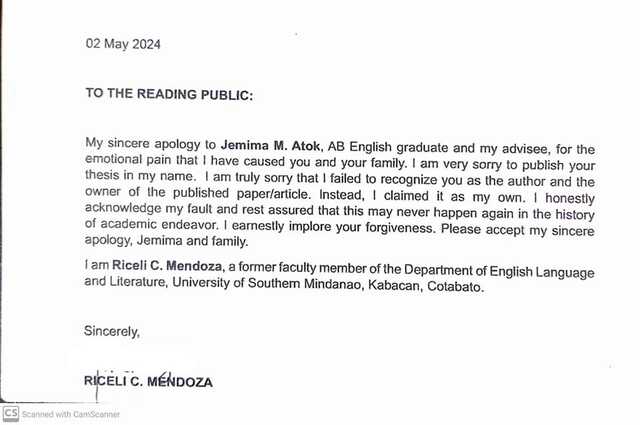
The statement has received over 21,000 reactions and 13,000 shares at press time.
WHAT WE KNOW ABOUT THE PLAGIARISM INCIDENT
According to USM's website, Mendoza was a former faculty regent and quality assurance director of the University of Southern Mindanao.
She was also in the board of trustees of the Accrediting Agency of Chartered Colleges and Universities in the Philippines, Inc.'s (AACCUP) from 2020 to 2023.
The university has not as yet provided a formal response to the issue.
For now, what is clear is that Mendoza is no longer part of USM.
Meanwhile, according to her LinkedIn profile, Atok has been a part-time instructor at USM since 2021.
REACTIONS TO PROFESSOR PLAGIARIZING HER STUDENT'S THESIS
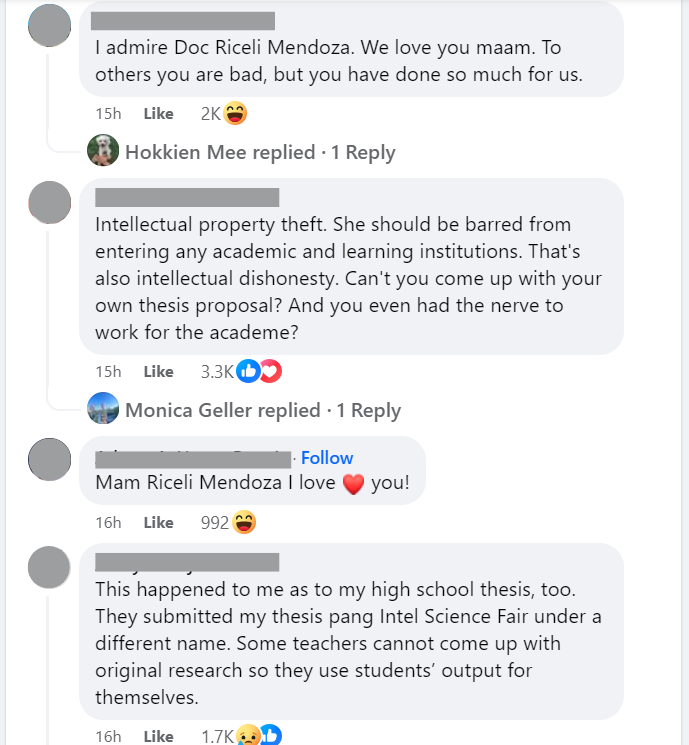
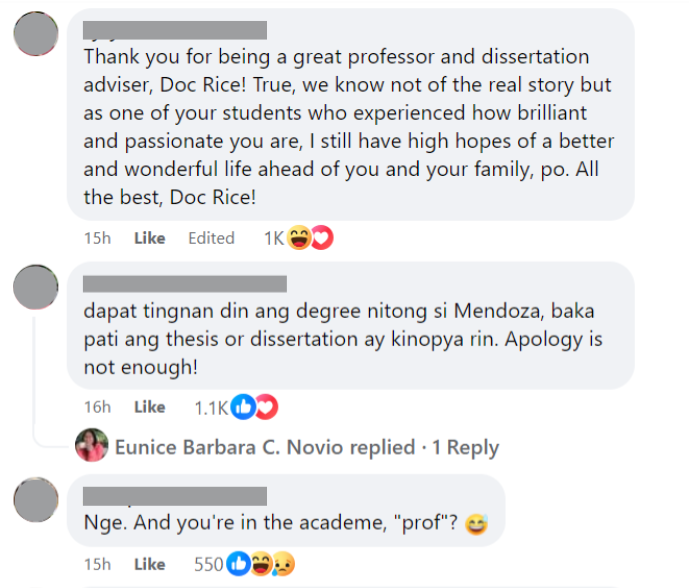
The comments section of the USM Facebook reveals a wide range of opinions.
Many of Mendoza's former students have expressed support for the teacher, saying: "to others you are bad, but you have done so much for us."
Others have not been as forgiving.
Also read: EXPLAINER: Can You Go to Jail for Plagiarism in the Philippines?
What the law sayS about plagiarism in the Philippines
In a 2012 advisory, the Department of Justice (DOJ) explained plagiarism as the "deliberate and knowing presentation of another person's original ideas or creative expressions as one's own."
It is an act of intellectual dishonesty that is particularly serious in fields that value originality, such as the academics and the arts.
Our Supreme Court requires evidence of "deliberate intent" to confirm plagiarism.
Plagiarism is not a crime under the Intellectual Property Code (IPC) unless it also constitutes copyright infringement.
Copyright laws protect original works for 50 years after the creator's death, but there is no time limit on protection against plagiarism.
However, when a work has been in the public domain for 50 years and more, it is free for anyone to use.
In instances where plagiarism overlaps with copyright infringement, the law is strict.
Penalties range from fines of PHP50,000 to PHP150,000 and imprisonment for a first offense, escalating to fines up to PHP1,500,000 and longer jail terms for repeated offenses.
But plagiarism by itself has significant fallouts.
In academic settings, plagiarism can lead to severe non-legal consequences—including loss of credibility, academic sanctions, expulsion from educational institutions, and damage to one's professional reputation.
Also read: Is It Ethical for Students to Use ChatGPT? We Ask a University Professor