
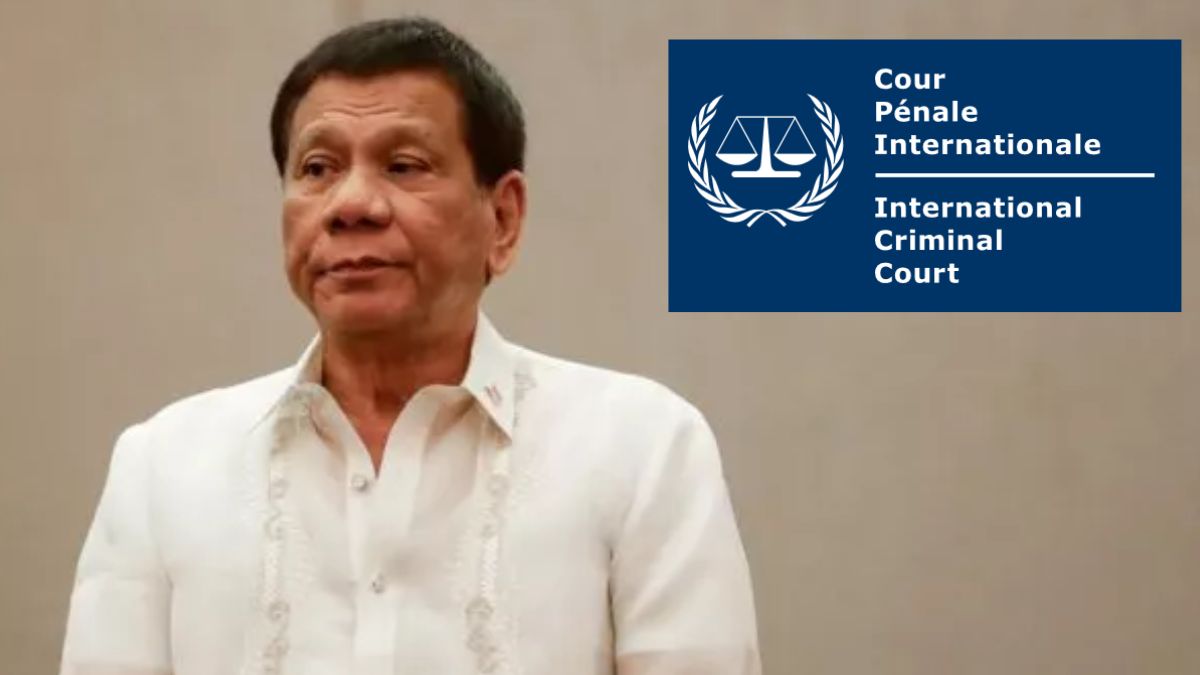

Inilabas sa media ang kopya ng warrant of arrest ng International Criminal Court (ICC) para kay dating Pangulong Rodrigo Duterte.
Ito ay kasunod ng pag-aresto ng Philippine National Police (PNP) kay Duterte sa Terminal 3 ng Ninoy Aquino International Airport nitong Martes, Marso 11, 2025.
Iniimbestigahan ng ICC si Duterte dahil sa sinasabing krimen nito laban sa sangkatauhan na nangyari habang siya ang nakaupong Pangulo ng Pilipinas mula Hunyo 2016 - Hunyo 22, 2022.
Binansagang EJKs—o ExtraJudicial Killings—ang pagkakapatay sa mga taong may involvement daw sa drug trade.
Ayon sa pna.gov.ph ng March 30, 2022, ang EJK figures ng Philippine Drug Enforcement Agency (PDEA) ay: "6,229 ang namatay sa isinagawang 226,662 anti-drug operations simula noong July 2016 hanggang January 31, 2022."
Ayon naman sa Commission on Human Rights (CHR) report ng November 2, 2021, ire-review nito ang "5,655 cases of anti-drug operations where deaths occurred including those being handled by the Administrative Order No. 35 Inter-agency Committee on Extra-Legal Series, Enforced Disappearances, Torture, and Other Grave Violations to Life, Liberty and Security of Persons."
Ang inilabas na warrant of arrest ng ICC kay Duterte ay pirmado ng tatlong judges ng Pre-Trial Chamber 1.
Ang Pre-Trial Chamber 1 ay binubuo ng tatlong babaeng judges: sina Julia Antoanella Motoc mula sa Romania, Reine Adelaide Sophie Alapini-Gansou mula sa Benin, at Maria del Socorro Flores Liera mula sa Mexico.
Ang petsang nakalagy sa warrant of arrest ay March 7, 2025.
Sa simula ng warrant of arrest ay nakasaad ito: "SITUATION IN THE REPUBLIC OF THE PHILIPPINES."
Read: Former President Rodrigo Duterte arrested on ICC warrant over drug killings
Ito ang buong kopya ng warrant of arrest na inilabas ng ICC:
THE ICC WARRANT OF ARREST
The Chambers, organised into Divisions as determined by article 39(1) of the Rome Statute, carry out the judicial functions of the Court. There are three Divisions: the Pre-Trial Division, the Trial Division, and the Appeals Division. The assignment of judges to Divisions is based on what functions each judge will perform and the qualifications and experience of the judge. This is done in a manner ensuring that each Division
PRE-TRIAL CHAMBER I (the ‘Chamber’) of the International Criminal Court (the ‘Court’) issues this warrant of arrest pursuant to article 58(1) of the Rome Statute (the ‘Statute’) for
Rodrigo Roa Duterte
a national of the Republic of the Philippines, born on 28 March 1945 in Maasin, Southern Leyte, the Republic of the Philippines.
I. Procedural history
1. On 19 April 2021, the Presidency assigned the situation in the Republic of the Philippines (the ‘Philippines’) to the Chamber.
2. On 15 September 2021, the Chamber, in a previous composition, authorised the
commencement of an investigation into the Situation in the Philippines (the ‘Philippines Situation’) in relation to crimes within the jurisdiction of the Court, allegedly committed on the territory of the Philippines between 1 November 2011 and 16 March 2019 in the context of the ‘war on drugs’ campaign.
3. On 24 June 2022, following a deferral request from the Philippines and a temporary
suspension of the investigative activities, the Prosecution requested the Chamber to authorise the resumption of the investigation into the Philippines Situation.
4. On 26 January 2023, the Chamber authorised the Prosecutor to resume the investigation into the Philippines Situation. On 18 July 2023, the Appeals Chamber confirmed this decision.
5. On 10 February 2025, the Prosecution, under seal and ex parte, only available to the Prosecution, applied for a warrant of arrest (the ‘Application’) for Rodrigo Roa Duterte (‘Mr Duterte’), as an alleged indirect co-perpetrator pursuant to article 25(3)(a) of the Statute for the following crimes against humanity within the Court’s jurisdiction, committed in the Philippines between 1 November 2011 and 16 March 2019 (the ‘Relevant Period’):
(i) murder as a crime against humanity (article 7(1)(a) of the Statute);
(ii) torture as a crime against humanity (article 7(1)(f) of the Statute); and
(iii) rape as a crime against humanity (article 7(1)(g) of the Statute).
II. Jurisdiction and admissibility
6. Pursuant to the first sentence of article 19(1) of the Statute, the Chamber finds, on the basis of the materials submitted and without prejudice to future determinations on the matter, that the case against Mr Duterte falls within the jurisdiction of the Court.11 The Chamber is satisfied that the incidents described in the Application amount to crimes against humanity that have allegedly been committed by Mr Duterte, a national of the Philippines. As to the temporal jurisdiction, the Chamber recalls, that ‘[w]hile the Philippines’ withdrawal from the Statute took effect on 17 March 2019, the Court retains jurisdiction with respect to alleged crimes that occurred on the territory of the Philippines while it was a State Party, from 1 November 2011 up to and including 16 March 2019.’ It further recalls that ‘[t]he Court’s jurisdiction and
mandate is exercised in accordance with the provisions of the Statute, an international treaty to which the Philippines was a party at the time of the alleged crimes for which the investigation was authorised. By ratifying the Statute, the Philippines explicitly accepted the jurisdiction of the Court, within the limits mandated by the treaty […]. These provisions and the ensuing obligations remain applicable, notwithstanding the Philippines[’] withdrawal from the Statute.’
7. As the alleged conduct has taken place between 1 November 2011 and 16 March 2019 on the territory of the Philippines, it falls within the Court’s jurisdiction.
8. At this stage, the Chamber declines to use its discretionary proprio motu power pursuant to the second sentence of article 19(1) of the Statute to determine the admissibility of the case against Mr Duterte as there is no ostensible cause or self-evident factor which impels it to do so.
III. Requirements of article 58(1) of the Statute
9. Article 58(1) of the Statute provides that the Pre-Trial Chamber shall, on the application of the Prosecutor, issue a warrant of arrest for a person if it is satisfied that there are reasonable grounds to believe that the person has committed a crime within the jurisdiction of the Court, and the arrest of the person appears necessary. The findings of facts, as set out below, are therefore made based on this evidentiary standard.
A. Whether there are reasonable grounds to believe Mr Duterte has committed a
crime within the jurisdiction of the Court (article 58(1)(a) of the Statute)
1. Contextual elements
10. On the basis of the material provided, and considering that the Davao Death Squad (‘DDS’) members and the Philippines’ law enforcement personnel15 targeted a very large number of persons allegedly involved in criminal activities,16 in particular drug-related ones, the Chamber finds that there was a course of conduct involving the commission of multiple acts against the civilian population on the territory of the Philippines.18 Moreover, these violent acts were initially committed by the DDS and subsequently by different governmental authorities and organs, pursuant to a policy aiming at putting an end to the criminality in the Philippines by all means, including killings of alleged criminals.
11. In light of the foregoing, the Chamber is satisfied that an ‘attack’ directed at a civilian population pursuant to an organisational policy during the period Mr Duterte had been the head of the DDS and a State policy during the period he had been the President of the Philippines, within the meaning of article 7(1) of the Statute, took place. Moreover, there are reasonable grounds to believe that this attack was both widespread and systematic: the attack took place over a period of several years, and thousands people appear to have been killed, a sample of which is analysed in the section below. The material before the Chamber shows that the killings shared common features, such as the location and modus operandi, including the
method of killing, the profiles of victims and the profiles of perpetrators.
12. The Chamber notes that the Prosecution alleges that some acts amounting to crimes against humanity of torture and rape, under articles 7(1)(f) and 7(1)(g) of the Statute, ‘were committed as part of a widespread and systematic attack directed against the civilian population’ and ‘pursuant to a State policy to attack alleged criminals’. However, although the information provided allows the Chamber to conclude that the material elements of the alleged crimes are fulfilled, the Chamber considers that the existence of a nexus between the alleged acts and the attack, as defined above, is insufficiently shown. Therefore, the allegations under Counts 2 and 3 cannot be retained for the purpose of the present warrant of arrest.
13. Considering Mr Duterte’s role and position during the Relevant Period as the Mayor of Davao City and the President of the Philippines and the fact that he was the head of the DDS, the Chamber finds that he necessarily knew about the operations and their scope. The matshows, as also illustrated below, 28 that by having defined the scope and purpose of the operations, Mr Duterte intended the conduct to be part of the widespread and systematic attack directed against all persons designated as involved in criminal activities, especially drugrelated ones.
2. The alleged crimes
14. Based on the material submitted by the Prosecution, which relates to a non-exhaustive list of incidents,30 the Chamber finds reasonable grounds to believe that, during the Relevant Period, murders of persons allegedly involved in various forms of criminal activities, including drug-related ones, were committed as follows:
a. at least 19 persons, allegedly drug pushers or thieves, were killed by members of the DDS in various locations in or around Davao City;
b. at least 24 persons, allegedly criminals – such as drug pushers and thieves – or drug users, were killed by or under the supervision of members of the Philippines’ law enforcement, sometimes with the assistance of persons who were not part of the
police, at various locations in the Philippines.
15. In light of the above findings, the Chamber considers that there are reasonable grounds to believe that the elements of the crimes against humanity of murder pursuant to article 7(1)(a) of the Statute are met and that the crime was committed in the territory of the Philippines during the Relevant Period.
3. Mr Duterte’s individual criminal responsibility
16. The Chamber finds that there are reasonable grounds to believe that, during the relevant period, Mr Duterte was the founder and head of the ‘DDS’, the Mayor of Davao City, and the President of the Philippines.
17. When Mr Duterte first became the Mayor of Davao City in 1998, he established the ‘Lambada Boys’, which acted as a ‘death squad’, composed of police officers and non-police hitmen, with a mission to kill criminals. In the early 1990s, the Lambada Boys were renamed ‘Davao Death Squad’. As the founder and head of the DDS and, later, the head of the State of the Philippines, Mr Duterte, jointly with high-ranking government officials and members of the police force (the ‘co-perpetrators’) and through other persons, agreed to ‘neutralise’ individuals they identified as alleged criminals or individuals with criminal propensities, including but not limited to drug offenders, initially in Davao and subsequently throughout the country. The word ‘neutralise’ was used and understood by those involved in the operations to mean to ‘kill’. This agreement had the aim of ‘address[ing] the growing criminality’ by ‘kill[ing criminals] in a very covert and secret manner’ without ‘stick[ing] to the basic law enforcement or investigation’, which had allegedly proven ineffective in eliminating or reducing the crimes.
18. As shown below, the Chamber finds reasonable grounds to believe that, in his role as the head of the DDS and subsequently the President of the Philippines, Mr Duterte used the direct perpetrators of the crimes as tools to commit the crimes.
19. Concerning the DDS, Mr Duterte had de facto control over this unit, which was organised in a hierarchal manner, with the physical perpetrators at the bottom and Mr Duterte at the top of the reporting line. His influence was further reinforced by the fact that, as the Mayor of the City, he had control over the police in the city with the power to direct the functions of police investigation, employ and deploy units or elements of the police, and choose the Davao City Police Chief. The members of the DDS automatically complied with their directions, even those that were merely implied. Their fungibility is shown by the fact that the DDS killed some of the physical perpetrators who did not follow their orders
20. As the President of the Philippines, Mr Duterte was the head of state who had de jure control over all the executive departments, bureaus and offices, including the Philippine National Police (‘PNP’), the National Bureau of Investigation (‘NBI’) and the Philippine Drug Enforcement Agency (‘PDEA’), and supervisory powers over local governments. He had the power to appoint key law enforcement officials and create the National Network, which killed those identified as alleged criminals and shielded perpetrators from being held accountable for their crimes. He also had the authority and the ability to suspend the operations temporarily and to reassign the operations to another government agency and has done so in response to public outcry.
21. Mr Duterte also had de facto control over all agencies implementing the National Plan, including the PNP and PDEA. He appointed co-perpetrators from Davao City to high-level national positions and subordinates who had been involved in the killings in Davao to other parts of the country. Those who committed the material elements of the crimes understood that they did not have the liberty to disobey orders from Mr Duterte to kill suspected criminals. Mr Duterte also took advantage of direct perpetrators’ issues and concerns, such as being suspected of drug-related offences, to ensure compliance with their superiors’ order to utilise them as tools to commit the crimes. Such low-level perpetrators’ fungibility can be inferred from the fact that they were killed or prosecuted as scapegoats to ensure that the highlevel perpetrators enjoy immunity.
22. Furthermore, Mr Duterte made essential contributions to committing the alleged crimes in the following manner:
a. Designing and disseminating a project aiming at targeting alleged criminals,
including during his presidency campaign, for the achievement of which the antiillegal drugs project ‘Double Barrel’ was launched, and subsequently endorsing this project;
b. Establishing and overseeing the DDS and providing it with firearms, ammunition,
vehicles, safehouses and communications equipment to perpetrate the killings;
c. Instructing and authorising violent acts to be committed against suspected criminals, including drug dealers and users;
d. Appointing key personnel to positions that were crucial in executing the crimes;
e. Offering financial incentives and promotions to police officers and ‘hitmen’ to kill the
suspects, promising immunity, and shielding them from investigation and
prosecution;
f. Making public statements authorising, condoning and promoting killings and dehumanising alleged criminals as the Mayor of Davao City and the President of the Philippines, including publicly naming suspects, some of whom were subsequently
killed in police operations; and
g. Authorising state actors to take part in the anti-drugs campaign and revoking such
authorisations.
23. As the Head of the DDS and subsequently the President of the Philippines and having made the aforementioned significant contributions, Mr Duterte had the power to frustrate the commission of the alleged crime.
24. Based on the material before it and the aforementioned findings, the Chamber further finds reasonable grounds to believe that Mr Duterte acted with intent and knowledge within the meaning of article 30 of the Statute in relation to the crime found to have been committed. The Chamber infers his knowledge and intent from, inter alia, his alleged conduct of establishing the DDS and the National Network and controlling them, together with his coperpetrators; instructing and supporting the city and nation-wide extrajudicial killings of alleged criminals; his public statements accepting responsibility for the killings committed pursuant to the State policy; supplying necessary equipment to implement the attacks; assuming responsibility for the attacks; and promising the police officers and hitmen immunity from prosecution.
25. Taking into account the totality of the information before it, the Chamber finds reasonable grounds to believe that Mr Duterte is individually responsible for the crime against humanity of murder (article 7(1)(a) of the Statute) as an indirect co-perpetrator within the meaning of article 25(3)(a) of the Statute, committed during the Relevant Period.
B. Necessity of the arrest
26. The Prosecution submits that the arrest of Mr Duterte is necessary to ensure his
appearance before the Court. After evaluating the information submitted by the Prosecution, the Chamber accepts that ‘there is no reasonable expectation that he would cooperate with a summons to appear issued by the Court’. The Chamber observes that Mr Duterte, even though no longer the President of the Philippines, appears to continue to wield considerable power. Mindful of the resultant risk of interference with the investigations and the security of witnesses and victims, the Chamber is satisfied that the arrest of Mr Duterte is necessary within the meaning of article 58(1)(b)(i) of the Statute to ensure his appearance before the Court.
FOR THESE REASONS, THE CHAMBER HEREBY
ISSUES a warrant of arrest for Rodrigo Roa Duterte, born on 28 March 1945, for his alleged criminal responsibility pursuant to article 25(3)(a) of the Statute for the crime against humanity of murder pursuant to article 7(1)(a) of the Statute, committed in the Republic of the Philippines during the Relevant Period, as set forth in this warrant of arrest;
DECIDES that the warrant of arrest, currently classified as secret, may be communicated, or its existence be revealed, and that the existence of the Prosecution’s application for the present warrant may be mentioned to States, international organisations or competent persons if required for the execution of the warrant of arrest;
DECIDES that the Registrar shall, if at the indication of the Prosecution a situation arises warranting to do so: (i) prepare a request for cooperation seeking the arrest and surrender of Mr Duterte, and containing the information and documents required by articles 89(1) and 91 of the Statute and rule 187 of the Rules of Procedure and Evidence; or (ii) prepare a request for provisional arrest pursuant to article 92 of the Statute, containing the required information and documents; (iii) transmit, in consultation and coordination with the Prosecution, the request, in accordance with article 87 of the Statute, to cooperate with the Court for the purpose of executing the request for arrest and surrender of Mr Duterte; and (iv) submit a progress report on the status of the execution of the request for cooperation no later than 15 days after the request is made;
DIRECTS the Registrar to prepare and transmit to any relevant State, in consultation and coordination with the Prosecution, any request for transit pursuant to article 89(3) of the Statute; and
ORDERS the Prosecution to transmit to the Registry all information available to it that may be of assistance in the execution of the request for arrest and surrender as well as any information of relevance to assessing any risks to victims and witnesses associated with the transmission of the request for arrest and surrender;
ORDERS the Registrar to register the warrant of arrest in the record of the situation and, once the suspect has been arrested, to open a case record and transfer first the Prosecutor’s Application from the situation record into the case record.