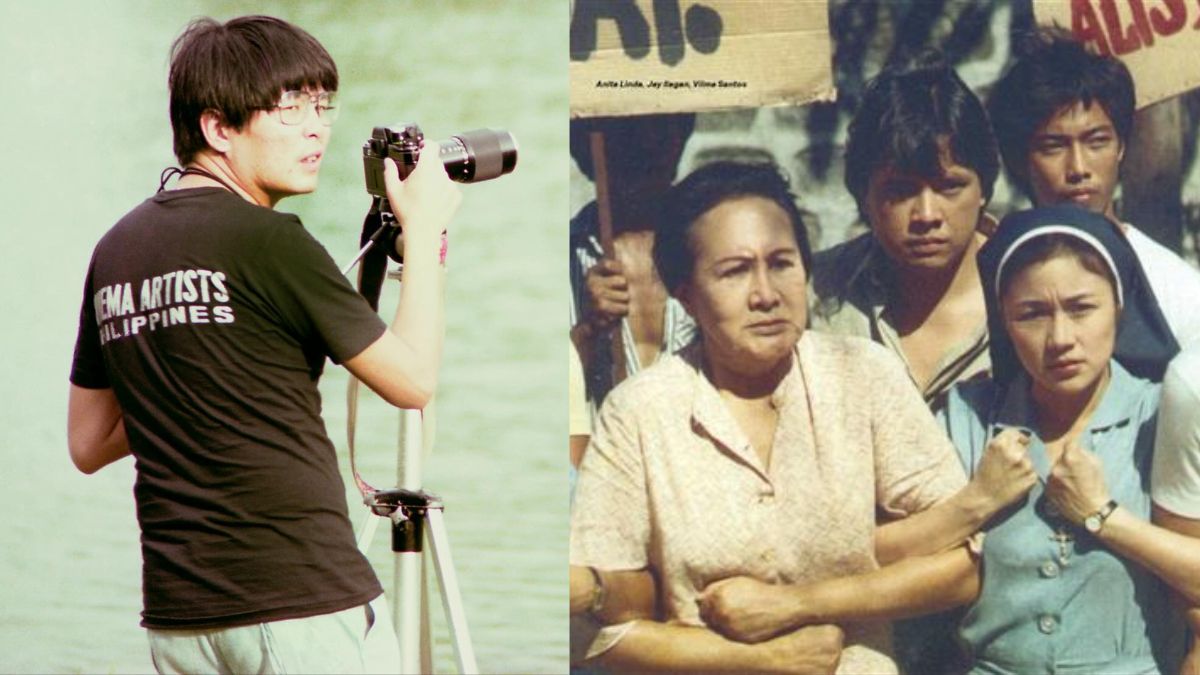

As the country mourns the death of film director Mike de Leon, the Philippine Entertainment Portal borrows from a Summit Books' title, SINE. FILM. PELIKULA. The Outstanding 100+ Philippine Movies of 100+ Years., due for release this 2025.
Read: Acclaimed director Mike de Leon dies
Five of De Leon's films are named among the 100+ films that SINE declares pridefully as true celebrations of the best of Philippine cinema.
SINE provides a quick guide to basic information about the films—language, year of release, director, screenwriter, producer, and cast; the synopses of each of De Leon's five movies; and a review of the movies themselves.
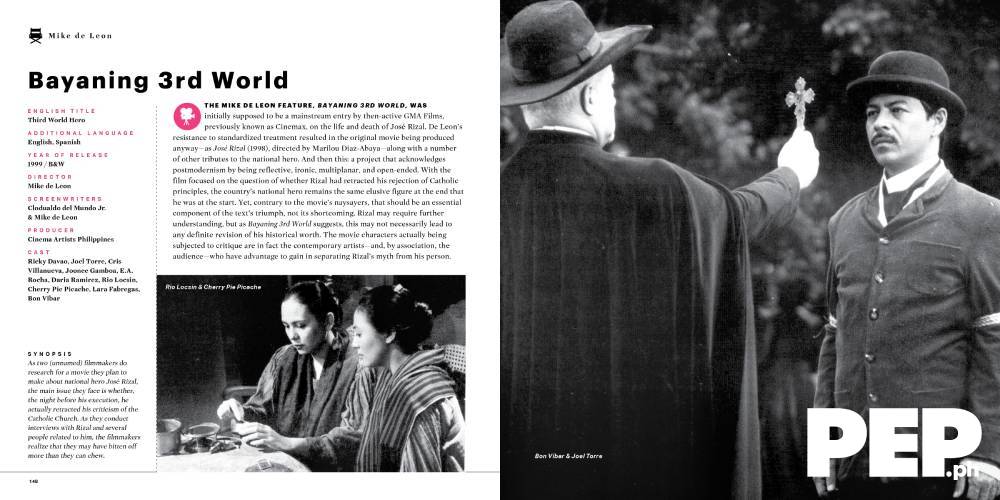
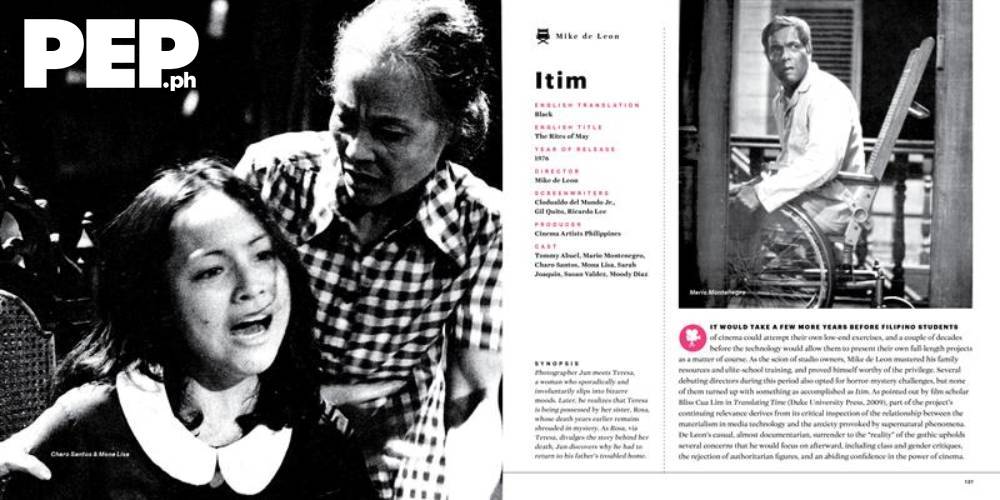
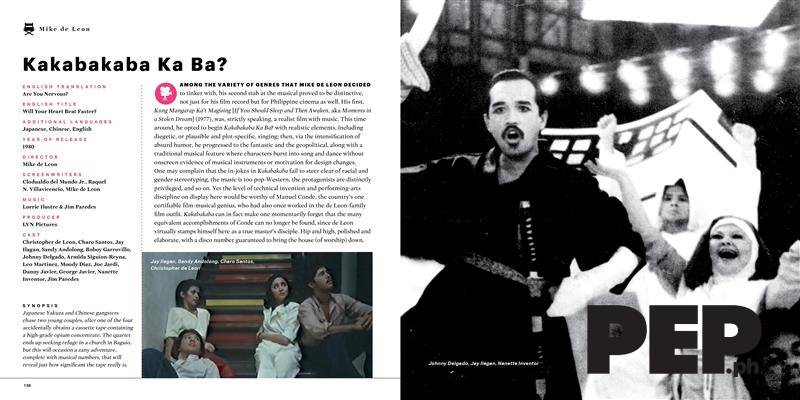
Shown here, for PEP readers, is the advance peek at the pages devoted to the director's craft and art.
A collaboration between editor Jo-Ann Q. Maglipon and cinema-studies scholar Joel David, Ph.D., the 300plus-page book, SINE, is set for release before Christmas 2025 by Summit Books.
1. Itim
ENGLISH TRANSLATION
Black
ENGLISH TITLE
The Rites of May
YEAR OF RELEASE
1976
DIRECTOR
Mike de Leon
SCREENWRITERS
Clodualdo del Mundo Jr., Gil Quito, Ricardo Lee
PRODUCER
Cinema Artists Philippines
CAST
Tommy Abuel, Mario Montenegro, Charo Santos, Mona Lisa, Sarah Joaquin, Susan Valdez, Moody Diaz
SYNOPSIS
Photographer Jun meets Teresa, a woman who sporadically and involuntarily slips into bizarre moods. Later, he realizes that Teresa is being possessed by her sister, Rosa, whose death years earlier remains shrouded in mystery. As Rosa, via Teresa, divulges the story behind her death, Jun discovers why he had to return to his father’s troubled home.
REVIEW
It would take a few more years before Filipino students of cinema could attempt their own low-end exercises, and a couple of decades before the technology would allow them to present their own full-length projects as a matter of course. As the scion of studio owners, Mike de Leon mustered his family resources and elite-school training, and proved himself worthy of the privilege. Several debuting directors during this period also opted for horror-mystery challenges, but none of them turned up with something as accomplished as Itim. As pointed out by film scholar Bliss Cua Lim in Translating Time (Duke University Press, 2009), part of the project’s continuing relevance derives from its critical inspection of the relationship between the materialism in media technology and the anxiety provoked by supernatural phenomena. De Leon’s casual, almost documentarian, surrender to the “reality” of the gothic upholds several concerns that he would focus on afterward, including class and gender critiques, the rejection of authoritarian figures, and an abiding confidence in the power of cinema.
Read: Mayor Vico Sotto calls out broadcasters over Discaya interviews
2. Kakabakaba Ka Ba?
ENGLISH TRANSLATION
Are You Nervous?
ENGLISH TITLE
Will Your Heart Beat Faster?
ADDITIONAL LANGUAGES
Japanese, Chinese, English
YEAR OF RELEASE
1980
DIRECTOR
Mike de Leon
SCREENWRITERS
Clodualdo del Mundo Jr., Raquel Villavicencio, Mike de Leon
MUSIC
Lorrie Ilustre & Jim Paredes
PRODUCER
LVN Pictures
CAST
Christopher de Leon, Charo Santos, Jay Ilagan, Sandy Andolong, Boboy Garrovillo, Johnny Delgado, Armida Siguion-Reyna, Leo Martinez, Moody Diaz, Joe Jardi, Danny Javier, George Javier, Nanette Inventor, Jim Paredes
SYNOPSIS
Japanese Yakuza and Chinese gangsters chase two young couples, after one of the four accidentally obtains a cassette tape containing a high-grade opium concentrate. The quartet ends up seeking refuge in a church in Baguio, but this will occasion a zany adventure, complete with musical numbers, that will reveal just how significant the tape really is.
REVIEW
Among the variety of genres that Mike de Leon decided to tinker with, his second stab at the musical proved to be distinctive, not just for his film record but for Philippine cinema as well. His first, Kung Mangarap Ka’t Magising [If You Should Sleep and Then Awaken, aka Moments in a Stolen Dream] (1977), was, strictly speaking, a realist film with music. This time around, he opted to begin Kakabakaba Ka Ba? with realistic elements, including diegetic, or plausible and plot-specific, singing; then, via the intensification of absurd humor, he progressed to the fantastic and the geopolitical, along with a traditional musical feature where characters burst into song and dance without onscreen evidence of musical instruments or motivation for design changes. One may complain that the in-jokes in Kakabakaba fail to steer clear of racial and gender stereotyping, the music is too pop-Western, the protagonists are distinctly privileged, and so on. Yet the level of technical invention and performing-arts discipline on display here would be worthy of Manuel Conde, the country’s one certifiable film-musical genius, who had also once worked in the de Leon-family film outfit. Kakabakaba can in fact make one momentarily forget that the many equivalent accomplishments of Conde can no longer be found, since de Leon virtually stamps himself here as a true master’s disciple. Hip and high, polished and elaborate, with a disco number guaranteed to bring the house (of worship) down.
Read: Lacson, Magalong bare kickback scheme in anomalous DPWH deals
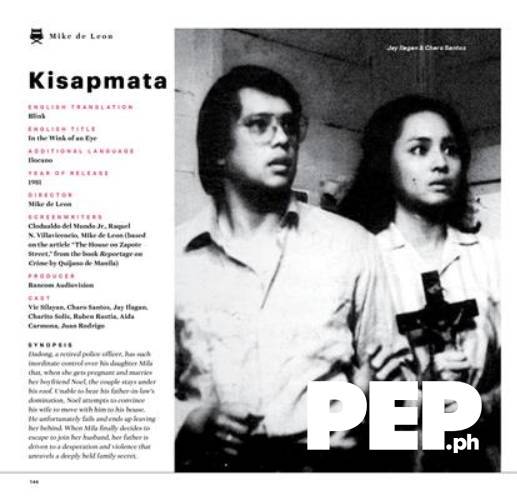
3. Kisapmata
ENGLISH TRANSLATION
Blink
ENGLISH TITLE
In the Wink of an Eye
ADDITIONAL LANGUAGE
Ilocano
YEAR OF RELEASE
1981
DIRECTOR
Mike de Leon
SCREENWRITERS
Clodualdo del Mundo Jr., Raquel Villavicencio, Mike de Leon (based on the article “The House on Zapote Street,” from the book Reportage on Crime by Quijano de Manila)
PRODUCER
Bancom Audiovision
CAST
Vic Silayan, Charo Santos, Jay Ilagan, Charito Solis, Ruben Rustia, Aida Carmona, Juan Rodrigo
SYNOPSIS
Dadong, a retired police officer, has such inordinate control over his daughter Mila that, when she gets pregnant and marries her boyfriend Noel, the couple stays under his roof. Unable to bear his father-in-law’s domination, Noel attempts to convince his wife to move with him to his house. He unfortunately fails and ends up leaving her behind. When Mila finally decides to escape to join her husband, her father is driven to a desperation and violence that unravels a deeply held family secret.
Read: Claudine Co, binabatikos dahil sa pagbalandra ng lavish lifestyle
4. Batch ’81
ADDITIONAL LANGUAGE
English
YEAR OF RELEASE
1982
DIRECTOR
Mike de Leon
SCREENWRITERS
Clodualdo del Mundo Jr., Raquel Villavicencio, Mike de Leon
PRODUCERS
MVP Pictures
CAST
Mark Gil, Sandy Andolong, Ward Luarca, Noel Trinidad, Ricky Sandico, Jimmy Javier, Rod Leido, Mike Arvisu, Dodo Cabasal, Edwin Reyes
SYNOPSIS
College student Sid and seven others make it as the latest potential members of the Alpha Kappa Omega (AKO) fraternity. While various hazing rituals force other neophytes to quit, these only strengthen Sid’s desire to be a full-fledged member. But AKO’s intensifying conf lict with a rival frat will soon prove to be the neophytes’ biggest hurdle yet.
REVIEW
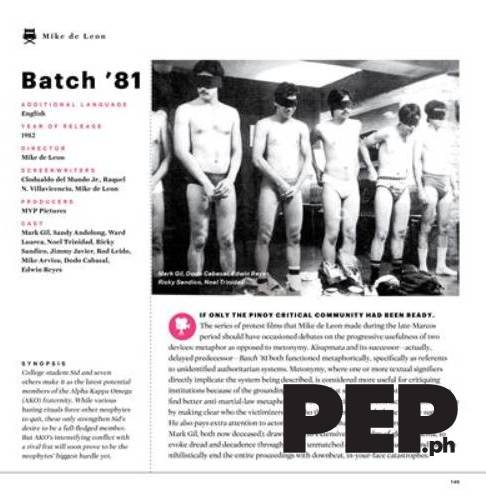
If only the Pinoy critical community had been ready. The series of protest films that Mike de Leon made during the late-Marcos period should have occasioned debates on the progressive usefulness of two devices: metaphor as opposed to metonymy. Kisapmata and its successor—actually, delayed predecessor—Batch ’81 both functioned metaphorically, specifically as referents to unidentified authoritarian systems. Metonymy, where one or more textual signifiers directly implicate the system being described, is considered more useful for critiquing institutions because of the grounding it provides. That said, one would still be hard put to find better anti-martial-law metaphors than these two titles. De Leon facilitates this analogy by making clear who the victimizers and who the victims are, and whose side he supports. He also pays extra attention to actors assigned the alpha-male characters (Vic Silayan and Mark Gil, both now deceased); draws from his extensive knowledge of global cinema, to evoke dread and decadence through locally unmatched audiovisual virtuosity; and dares to nihilistically end the entire proceedings with downbeat, in-your-face catastrophes.
Read: Gela Alonte responds to backlash over political dynasty remark
5. Sister Stella L.
ADDITIONAL LANGUAGE
English
YEAR OF RELEASE
1984
DIRECTOR
Mike de Leon
SCREENWRITERS
Jose F. Lacaba, Jose Almojuela, Mike de Leon
PRODUCER
Regal Films
CAST
Vilma Santos, Jay Ilagan, Gina Alajar, Laurice Guillen, Tony Santos, Anita Linda, Liza Lorena, Eddie Infante, Ruben Rustia, Adul de Leon, Rody Vera, Malu de Guzman, Fernando Modesto
SYNOPSIS
Moved by the stories of a namesake nun about the plight of laborers in her area, Sister Stella Legaspi leaves her job counseling unwed mothers in order to support workers’ protests. When her safety is threatened, the young nun is ordered back to her convent. She finds a way to return to the workers, but soon discovers that her commitment to activism has arrived at a crossroads.
REVIEW
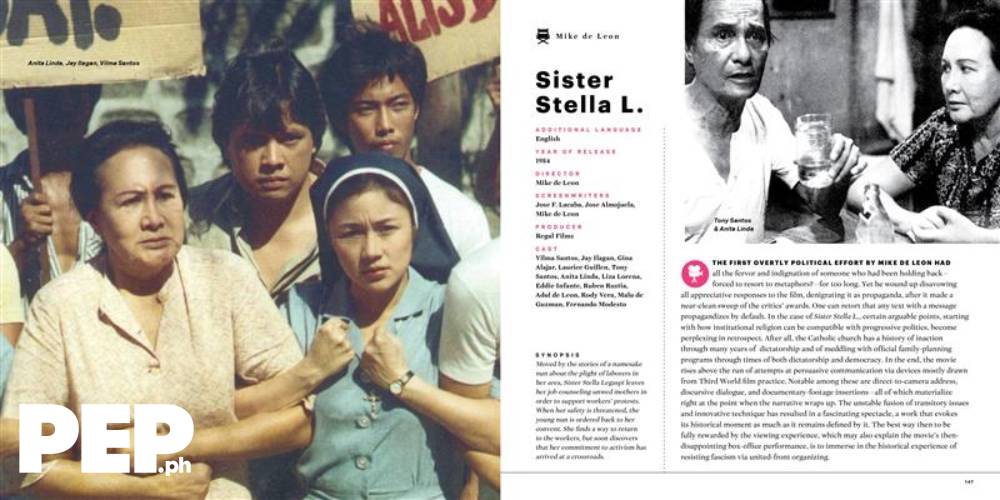
The first overtly political effort by Mike de Leon had all the fervor and indignation of someone who had been holding back—forced to resort to metaphors?—for too long. Yet he wound up disavowing all appreciative responses to the film, denigrating it as propaganda, after it made a near-clean sweep of the critics’ awards. One can retort that any text with a message propagandizes by default. In the case of Sister Stella L., certain arguable points, starting with how institutional religion can be compatible with progressive politics, become perplexing in retrospect. After all, the Catholic church has a history of inaction through many years of dictatorship and of meddling with official family-planning programs through times of both dictatorship and democracy. In the end, the movie rises above the run of attempts at persuasive communication via devices mostly drawn from Third World film practice. Notable among these are direct-to-camera address, discursive dialogue, and documentary-footage insertions—all of which materialize right at the point when the narrative wraps up. The unstable fusion of transitory issues and innovative technique has resulted in a fascinating spectacle, a work that evokes its historical moment as much as it remains defined by it. The best way then to be fully rewarded by the viewing experience, which may also explain the movie’s then disappointing box-office performance, is to immerse in the historical experience of resisting fascism via united-front organizing
Read: Is Kathryn Bernardo moving to this luxe abode in Makati City?
6. Bayaning 3rd World
ENGLISH TITLE
Third World Hero
ADDITIONAL LANGUAGE
English, Spanish
YEAR OF RELEASE
1999 / B&W
DIRECTOR
Mike de Leon
SCREENWRITERS
Clodualdo del Mundo Jr. & Mike de Leon
PRODUCER
Cinema Artists Philippines
CAST
Ricky Davao, Joel Torre, Cris Villanueva, Joonee Gamboa, E.A. Rocha, Daria Ramirez, Rio Locsin, Cherry Pie Picache, Lara Fabregas, Bon Vibar
SYNOPSIS
As two (unnamed) filmmakers do research for a movie they plan to make about national hero José Rizal, the main issue they face is whether, the night before his execution, he actually retracted his criticism of the Catholic Church. As they conduct interviews with Rizal and several people related to him, the filmmakers realize that they may have bitten off more than they can chew.
REVIEW
The Mike de Leon feature, Bayaning 3rd World, was initially supposed to be a mainstream entry by then-active GMA Films, previously known as Cinemax, on the life and death of José Rizal. De Leon’s resistance to standardized treatment resulted in the original movie being produced anyway—as José Rizal (1998), directed by Marilou Diaz-Abaya—along with a number of other tributes to the national hero. And then this: a project that acknowledges postmodernism by being reflective, ironic, multiplanar, and open-ended. With the film focused on the question of whether Rizal had retracted his rejection of Catholic principles, the country’s national hero remains the same elusive figure at the end that he was at the start. Yet, contrary to the movie’s naysayers, that should be an essential component of the text’s triumph, not its shortcoming. Rizal may require further understanding, but as Bayaning 3rd World suggests, this may not necessarily lead to any definite revision of his historical worth. The movie characters actually being subjected to critique are in fact the contemporary artists—and, by association, the audience—who have advantage to gain in separating Rizal’s myth from his person.