
A
day after the 2009 Cinemalaya Philippine Independent Film Festival, indie film
enthusiasts are still debating the list of winners. (Click HERE to view the complete list of winners in Cinemalaya Cinco.)
Spectators who did not get to see most of the films are just relying on
reviews. That's why it's welcome news to learn that the University of the Philippines Film Institute
will be holding screenings of the competing entries. See the 10 full-length films
and 10 short films from July 28 to
August 4 at UP Diliman, Quezon City.
This is especially good for short films in the competition, which may have a more
difficult time getting screened outside of the festival. A total of 26 entries
were submitted to the short feature category of Cinemalaya 2009 but only then
were selected for competition. Here is a chance to see them again.
Screening
schedules for the short films at the UP Diliman are as follows: July 30, Thursday 3 p.m. - Shorts A (Musa, Behind Closed Doors,
Tatang, Hulagpos, Wat Floor Ma'am) 5
p.m. - Shorts B (Ugat sa Lupa, Si Bok
at and Trumpo, Latus, Blogog, Bonsai).
Click HERE to view the schedule of the full-length films to be screened at UP
Diliman.
SHORTS A
MUSA
Direction and Screenplay: Ariel M. Reyes
They say that one man's medicine is another man's poison. An old man who
has a habit of quoting poetic passages has gained a reputation for being a
faith healer in the slun tenements. Tatang (Nanding Josef) can heal physical injuries
but cannot bring the dead back to life, an ability that causes his neighbors to
admire but shun him at the same time. He shares this outcast situation with the
gay parlorista (Carlon Matobato) who is the butt of jokes among the men
but a source of comfort among the women of the depressed neighborhood. Tatang
and the gay beautician also share the same dream: that of a beautiful
godess-like creature who hounds them in their dream when they are in deep
thought of their aspirations.
Musa is strong in technical aspects. The scenes are clean and the
transitions are smooth. However, without a solid story core, this goes to waste
since the audience is left confused rather than enlightened. My guess is that Musa is a take on man's subjective view
of things around him depending on how it favors him in the end.
BEHIND CLOSED DOORS
Direction and Screenplay: Mark Philipp Espina
Moving in flashbacks, Behind Closed Doors
is a passionate dark comedy about a stagnant relationship that survives
because of the small lies and narrow escape paths that both parties slip into
to preserve the status quo of the union.
Butch and Sarah are a married couple whose relationship is not as good as it
had once been. One night, Sarah finds a banana flavored condom among her husband's
things. Butch, on the other hand, finds a vibrator between the sheets of their
marital bed. Will their secrets be unraveled or will they choose to hide behind
lies that are technically truths?
Behind Closed Doors is commendable
for its great storyline and its overall cohesion. Despite the numerous
flahsbacks, the scenes fall back into place without missed details.
TATANG
Direction: Jean Paolo Hernandez
Screenplay: Ipe Asuncion
In the Cinemalaya Cinco program, Tatang
did not look promising. The story, after all, is about an old man who makes
ends meet by stealing with his grand daughter as his apprentice, a plot already
abused in television melodramas. But as it progresses, the curious relationship
between Tatang Ruding and the young Ester unfolds.
Refusing to accept their dependence on each other, Tatang Ruding verbally
demoralizes Ester, calling her stupid. In turn, Ester spats back at him but
exhausts her skills at theft to bring home food--all to prove to the grumpy old man that
she is not stupid as he tells her she is.
Tatang is a fresh take on the modern parent-child relationship. It
depicts how parents, for fear of not being needed, assert superiority at all
cost and impose guilt on their children. Children, in turn, struggle to maintain
independence even as they are haunted by a life-long parental responsibility
that their either resent or accept.
The film puts a positive spin on this gritty social reality by creating an
unfortunate incident as a catalyst to reconcile the differences between Ester
and Tatang Ruding and to show their acceptance of their symbiotic relationship.
But this also caused the film to fall into the melodramatic trap in the end
when Ester and Tatang Ruding hug ala Maalaala Mo Kaya. Nonetheless, it is one
of the better crafted and better thought of films in the shorts roster.
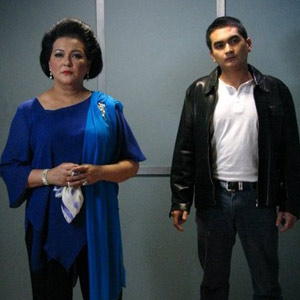
WAT FLOOR MA'AM
Direction: Mike Sandejas and Robert Sena
Screenplay: Robert Sena
In the souvenir program, the film evoked curiosity among viewers. After all, it
involves a "flamboyant former First Lady of the Philippines,"
undeniably an allusion to Madame Imelda Marcos herself, and a "Bad Boy
actor from local cinema," another undeniable allusion to Robin Padilla,
"trapped inside an elevator of an old government building." Of
all the shorts in the competition, I was looking forward to this one the most,
imagining the shocking revelations and controlled drama in tight quarters.
However, Wat Floor Ma'am started to
fall apart from the start. The combination of characters itself was not
justified. Why on earth did the imaginary Madame Imeldific got trapped in a
government elevator with a mock-up Binoy was not explained. And who does Binoy
represent anyway to ask Madame upfront: Did you really steal the wealth of the Filipino people?
I had high hopes for this film. Being claustrophobic, I imagined the pressure
of being asked a painful and direct question in a cramped elevator in a decaying
building. All the reason for me to believe that the film is an ambitious
attempt at capturing a slice of Imelda Marcos' personality but only succeeded
in recreating in what is already there instead of creating a new interpretation
of Imelda.
Wat Flor Ma'am is entertaining enough
because of its obviously comic elements like a Chinese man suddenly appearing
from nowhere or the elevator suddenly being converted into a theater but that's
all there is to it.
HULAGPOS
Direction and screenplay: Maita Lirra Lupac
In an old townhouse, a young girl grows up under the watchful eye of her
austere mother. One of her mother's strict orders is to never to enter a
forbidden room in the house. Overpowered by a child's curiosity, Angeli opens
the room and discovers her mother's terrible secret.
Hulagpos has a gripping dark ambiance that is consistent throughout the
film. Through flashbacks, the mother's awful past is rendered like a gothic
tale of a desperate and forbidden love nipped too late. Inside the forbidden
room, life-sized statues of Catholic saints tell Angeli the awful past with
their furrowed brows and dark eyes.
SHORTS B
UGAT SA LUPA
Direction and Screenplay: Ariel M. Reyes
Ugat sa Lupa is like an Amorsolo painting that came to life: sunny open
fields, clear-faced brown people, and colorful fabrics. It is a refreshing
break from the gloomy settings of the other films in competition.
The non-dialog film dramatizes the hardships of a young a farming family living
in an island bereft of fresh water. To survive, they have to travel to another
island to fetch fresh water. Enjoying a simple and peaceful life but deprived
of a very basic need, the family's life is a mirror of man's basic existence on
earth-a life of hard work.
Being a non-dialogue film that is not plot-driven, it automatically becomes am
acting piece. At this point, we were not disappointed by Gerald Madrin and
Angeli Urquico who plays the male and female leads. With the use of ambient
sounds and simple music, we are lulled back to a bygone era of traditional
family life.
SI BOK AT ANG TRUMPO
Direction and screenplay: Hubert Tibi
Si Bok at ang Trumpo is a lighthearted take on childhood mischief. A
young boy named Bok irks his grandmother by making holes on her floor with his
old-fashioned toy top (trumpo). The
old lady then vents it out on Bok's mild-mannered mother for marrying a poor
man who cannot afford to buy Bok more expensive toys other than his destructive
and antiquated trumpo. On top of it all,
the neighborhood kids also tease Bok for having a mere trumpo for a toy. One day, Bok find his toy top broken and he knows
his grandmother did it. What follows is how Bok exacted revenge on everybody.
Despite having a very simple premise, the film is a huge crowd pleaser. The
audience really loved how witty retorts were sprinkled throughout the movie.
Jose Enrique Perez, who plays Bok, is disarmingly cute you can easily forgive
him for doing mischief. After laughing, the reality of childhood is there:
children forgive but they do not forget.
LATUS
Direction and Screenplay: John Paul S. Seniel
Latus is an advocacy film fighting
against corporal punishment at home. Based on the real-life stories of two
teenagers living in a slum area in Davao, Latus tells the story of Vicknelyn
and Jenelza, both 16 and physically abused by their fathers. Immune to pain and
frustrated with her situation at home, Vickenelyn joins young gang riots while
Jenelza chooses the less detructive path and focuses on school. One day,
Jenelza witnesses Vicknelyn having a crazy breakdown in front of her abusive
father and eventually became crazy herself.
Latus enters a world where women have long accepted that as long as a
man puts rice on the table, it is alright for him to beat them.
BLOGOG
Direction and Screenplay: Rommel
Tolentino
A young boy alienated by neighborhood kids finds a filthy, yellow ball-that
turns out to be a magical ball!-down by the creek. An film with no clear
premise, Blogog is enjoyable because of two things: it is open to many
interpretations and has many funny moments.
After finding the magical ball, the boy finds contentment in solitude and even
discovers a skill in basketball, symbolic of finding himself.
BONSAI
Direction and Screenplay: Alfonso "Borgy"
Torre III
Bonsai is a touching and
uncomplicated story of a man who does the unthinkable to win the heart of his
lady love.
Romy (Richard Somes) is a plump and funny security guard whose aspirations in
life are as simple and manageable as the bonsai plants he care of in his spare
time. The only extreme of his emotions is his unexpressed love for Daisy (Angel
Aquino), the laundrywoman in one of the houses in the neighborhood. To win her
love, Romy does everything to lose weight. One day, he finds Daisy hanging out
clothes to dry while sharing a pleasant laugh with an obviously more
good-looking and more physically trim stranger.
Bonsai is charming in the clean and
linear presentation of the story. Like Romy, its goal is simple: to depict a
person's insecurity and the extent of transformation one is willing to go
through for love. It is also a reflection of the pain experienced by a shallow
dreamer whose simple dreams
fail him.

NPC Seal of Registration
PEP.ph has been granted the NPC Seal of Registration in recognition of the successful registration of its DPO and DPS
© 2026 Philippine Entertainment Portal Inc. All Rights Reserved