

The turbulent Seventies in the Philippines has been a rich source of material for the local arts. Through films, television, theater, music, and literature, this decade has been immortalized in forms beyond the usual history textbooks. But terms like martial law, socialism, and fascism and the like are slowly becoming just remnants of the past.
That's why 40 years after the First Quarter Storm of 1970, a director who lived during this historical period tapped producers and artists to create a movie that would tell a story of that tumultous time.
This movie is Sigwa, one of the entries that competed in the 6th edition of the Cinemalaya Philippine Independent Film Festival. Written by Boni Ilagan, Sigwa is the entry of Joel Lamangan in the Director's Showcase category.
Direk Joel, who shifts from laugh-out-loud comedies to socio-political dramas, once shared how the subject matter of Sigwa is close to his heart, having experienced first-hand the violence and brutality of the decade while the country was under the dictatorship of former President Ferdinand Marcos. These experiences are effectively reflected in this film, the latest addition to our vast collection of Martial Law-inspired artistic accounts.
FQS AND BEYOND. Sigwa brings us back to the glory days of youth activism, when activists frequented not bars but hideouts and mountains, when they used the media not for social networking but for underground revolutionary propaganda . The film commemorates 14 years of social unrest; at the same time, it captures the human side of activism.
The First Quarter Storm (FQS) refers to the student revolt from January to March in 1970 when mass demonstrations against then President Ferdinand Marcos's regime swept through Manila. The riot police used brute force to disperse the demonstrators.
Sigwa dramatizes the interconnecting lives of young people with a militant past who all lead different lives many years later. Their stories unfold through a series of non-linear flashbacks showing viewers what happened during the First Quarter Storm and the violent years after it. Torture scenes and rape sequences recount the atrocities perpetrated during the dictatorship.
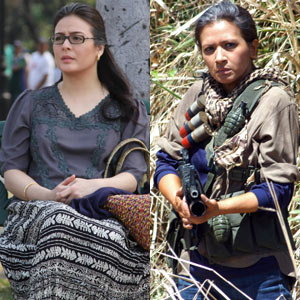
The film begins with the arrival of Dolly (Dawn Zulueta), a Fil-Am citizen who comes back to the Philippines to look for her daughter. In the 1970s, she was a journalist turned activist who fell in love with Eddie (Allen Dizon). Dolly left her daughter under the care of Azon when she was arrested during a raid. Her comrades let Dolly believe that her daughter was dead; in reality, Azon wanted to claim the child as her own.
Dolly realizes that much has changed in Manila since she was deported to the United States. Ironically, she sees that although some things changed, things remain the same, particularly for the masses.
The balikbayan now sees the consequences of the choices she and her comrades made when they were young. Cita and Rading, for example, remain true to their cause, notwithstanding hardships and imminent danger. Others like Oliver did a 180-degree turn in order to lead "normal" and comfortable lives. Still others were so traumatized by the experience, like Azon, that they would rather forget the grim past.
ENSEMBLE FILM. Dawn does well in her first indie film, having the warmth and sincerity necessary to make the character of an outsider genuinely care for what's left in her homeland.
And although Sigwa is told from the point of view of her character, this movie is impressive because it does not leave out the other characters. Through this film, Direk Joel shows his mastery in creating an ensemble film.
Zsa Zsa Padilla is surprisingly believable as Cita, a high-ranking officer in the New People's Army. Viewers will see the Divine Diva in a different light as she dons military fatigues and carries high-powered weapons while patrolling various towns in the province. She even engages military agents in a car-chase scene. Her character harbors resentment towards her former boyfriend, Oliver, who betrayed the cause while they were still activists.
Tirso Cruz III is outstanding as Oliver, who exhibits the hubris of an unapologetic high-ranking palace official. One of the highlights of the film is Oliver's debate with Cita in a funeral parlor where he and Cita trade barbs about the need for revolutionary change in society. As Oliver walks away, he makes a grand exit with both hands flashing the "f*ck you" sign. Tirso bagged the Best Supporting Actor plum in this year's Cinemalaya for his portrayal of the cynical presidential spokesperson.
It is Oliver who helps Dolly find Azon (Gina Alajar) whose facial expressions alone tell of the nightmare brought upon her life by the tumultuous past. Gina gives a subtle yet powerful performance as the world-weary Azon.
The younger set of actors display sheer tenacity as they give life to their characters with fire in their eyes and angst in their hearts. It is interesting to observe how the younger actors and their mature counterparts were able to move and act in similar ways, indicating that the filmmakers took the time and effort to polish the performances of the stars.
Megan Young as the '70s Dolly is cast perfectly as the gentle newcomer who evolves into a young idealistic woman willing to sacrifice for the revolution. Lovi Poe as young Azon mirrors Gina's meek strength, Marvin Agustin as young Oliver is ambitious and sly, even Jay Aquitania's lightheartedness is transported as he matures into the old Rading, played by Jim Pebangco.
MESSAGE TO THE YOUTH. The movie effectively weaves together fictional characters and situations with real people and historical accounts. The Sigwa character Oliver, the staunch defender of the controversy-besieged Pres. Gloria Macapagal Arroyo, has a similar background with real-life Malacañang spokesperson Gary Olivar who used to be an activist in the pre-Martial Law years.
The movie, however, could have done better in designing the flashbacks with a more believable '70s look and feel. Even the costumes and the artifacts lack authenticity. And with a great collection of genuinely Filipino and organic-sounding revolutionary music of the '70s activist culture, the movie could have used more of this sound, especially in the musical scoring.
But Sigwa's job does not end by being graded A by the Cinema Evaluation Board. It is the movie's goal to be seen by more people, especially the youth who were not yet alive during the time of Marcos and slain political hero Ninoy Aquino.
Through this movie, viewers will be able to better appreciate the ideals of activism. By witnessing the passion of these revolutionaries, today's generation will hopefully see the relevance of youth activism in the present times and realize how these ideals are still applicable to current circumstances. As one of the characters mentions in Sigwa, the seeds of change were sown during the time of the First Quarter Storm. This seed has grown into a tree now, and it is up to the new generation to continue what they had started.
Above all, Sigwa shows that the freedom we all enjoy today is not to be taken for granted. It is borne out of the sacrifices that countless Filipinos willingly made for the sake of our belovedInang Bayan.
(With reports from Fidel Antonio Medel)