



Hollywood has lost a king.
Chadwick Boseman, the actor who brought to life King T'Challa of Marvel's Black Panther comic book franchise, has died at the age of 43.
His death came after a four-year battle with colon cancer, a revelation that shocked many of his fans.
Chadwick was diagnosed with cancer in 2016, the year he made his debut in the Marvel Cinematic Universe as Black Panther.
The character was a newbie in an ensemble of well-established superheroes played by internationally known superstars—Robert Downey's Iron Man and Chris Evans' Captain America.
But Chadwick's Black Panther was still a scene-stealer in Captain America: Civil War.
His presence rivalled the star power of Downey and Evans, staging Boseman as a future pillar of the Marvel cinematic universe.
This became more apparent when Chadwick fleshed out the character of King T'Challa in a solo outing of Black Panther in cinemas. The film broke global box-office records, becoming, at press time, the 10th highest grossing film of all time.
Black Panther also became a nominee for Best Picture in the 2019 Academy Awards, a first for comic book and superhero movies.
the significance of black panther
The existence of Black Panther has proven to be a cultural reboot that Hollywood, and maybe even the world, needed at the time and, quite possibly, still does.
As writer Jamil Smith puts it in his February 2018 article for Time magazine, Black Panther is a movie that represents "what it means to be black in both America and Africa—and, more broadly, in the world."
Theatrically released February 16, 2018, the Marvel Studios film arrived at a time when Hollywood was under more strident criticism for its lack of diversity and representation.
Indeed, traditional Hollywood films often have white, multifaceted characters in its center, while persons of color—Hispanic, African-American, Asian—are generally portrayed as one-dimensional characters playing assist to white leads.
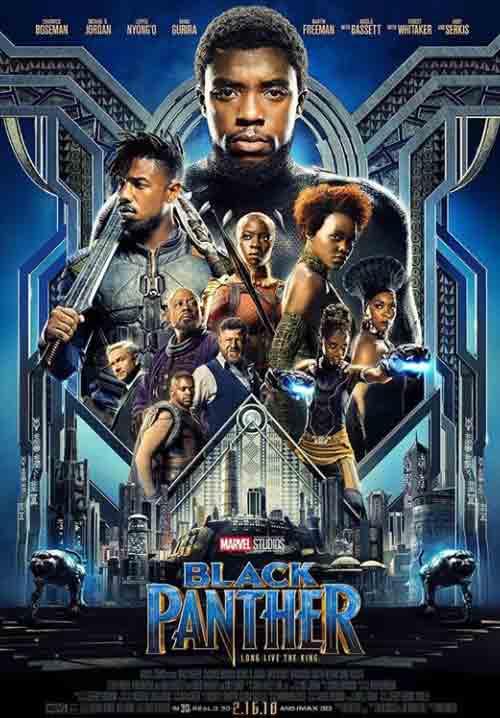
The phenomenal success of Black Panther, which featured an all-star lead cast of African-American actors, became proof that persons of color could command a story and an audience.
As the Time piece underscores: "African-American narratives have the power to generate profits from all audiences. And, more important, that making movies about black lives is part of showing that they matter."
Black Panther also happened under the Trump administration, an important detail Time points out: "In the midst of a regressive cultural and political moment fueled in part by the white-nativist movement, the very existence of Black Panther feels like resistance."
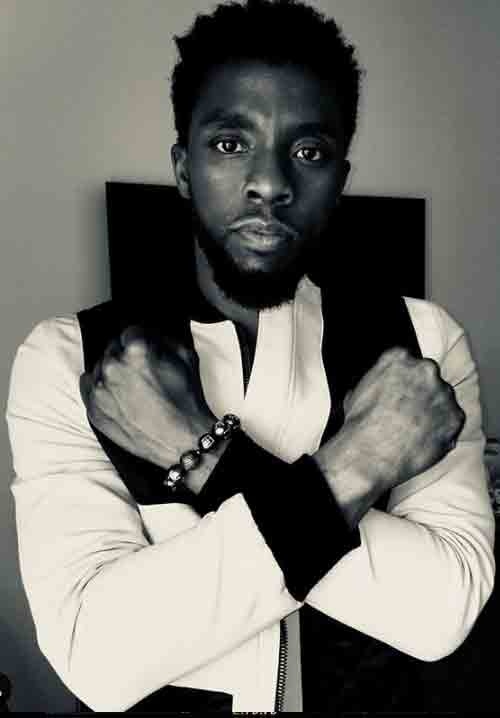
To have had Chadwick at the forefront of this "resistance" is both meaningful and fitting.
the uphill climb
Chadwick is a graduate of Howard University, a private institution in Washington, D.C., that is a predominantly black.
After his worldwide press tour for Marvel Studios, Chadwick returned to Howard University to deliver the commencement speech to the class of 2018.
In his speech, the actor recalled his first taste of inequality in Hollywood.
Fresh out of college, Chadwick had experienced a successful run in New York. He landed a lead role in a professional play on his first try. This led him to a meeting with his first agent, which led him to landing his first television role.
The role was for a soap opera, and Chadwick was thrilled because he had already been promised a six-figure salary for the gig. But things took a turn for the worse when he received the script.
As Chadwick recalled it in his speech: "The role wasn't necessarily stereotypical. A young man in his formative years with a violent streak, pulled to the allure of gang involvement.
"That's somebody's real story. 'Never judge the characters you play,' that's what we were always taught. That's the first rule of acting."
But the actor couldn't shake off his doubts. He continued, "The writing failed to search for specificity. Plus, there was barely a glimpse of positivity or talent in the character. Barely a glimpse of hope. I would have to make something out of nothing. I was conflicted."
After shooting the first two episodes of the soap opera, executives called Chadwick to a meeting. The actor saw this as a chance to discuss his character and his backstory.
At the meeting, executives told Chadwick they were impressed with his acting and wanted him to stay on the show "for a long time."
If he needed anything, "just let them know."
Chadwick laid down his concerns: "I decided to ask them simple questions about the background of my character. Questions that I felt were pertinent to the plot.
"Question number one: where's my father?"
The executives replied, "He left when you were younger, of course."
Chadwick gave them benefit of the doubt and proceeded with his next question: "In this script, it alluded to my mother not being equipped to operate as a good parent. So, why exactly would my little brother and I have to go into foster care?"
Their answer: "Well, of course, she's on heroin."
This response no longer sat well with Chadwick. "If we're around here assuming that the black characters on this show," he remarked, "are criminals, on drugs, and deadbeat parents, then that probably would be stereotypical, wouldn't it?”
The atmosphere changed after that.
Chadwick was removed from the project the next day, and he was tagged "difficult." Chadwick's agent at the time told him, "It might be a while before [you] get a job onscreen again."
Chadwick's initial reaction was to go back to his original plan: to become a writer-director and tell his own stories. But there was a part of him that got more conflicted about where he stood in the industry.
In hindsight, Chadwick reflected, "Sometimes you need to get knocked down before you can really figure what your fight is and how you need to fight it."
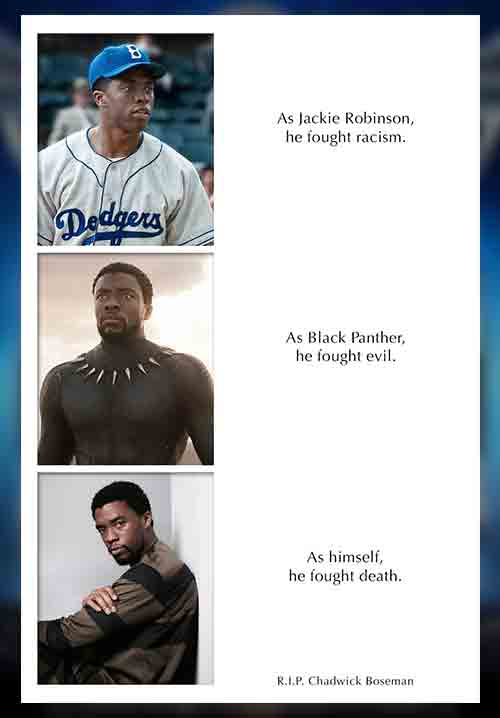
In 2013, Chadwick got his big breakout role in Hollywood with the biopic 42. He played Jackie Robinson, the first African-American professional baseball player to break Major League Baseball's infamous "color barrier."
White baseball players and Black baseball players were segregated at the time. Persons of color played for the "Negro Leagues." Robinson's achievement was not only pivotal to the history of sports, it was to Black history. Robinson's activism contributed to the civil rights movement.
A year after, Chadwick portrayed African-American singer James Brown in Get on Up. Just as Robinson is a legend in baseball, Brown is an icon in music.
In 2017, Chadwick played the role of Thurgood Marshall in the film Marshall. The titular character is the first African-American Supreme Court justice, and he plays an instrumental role in the civil rights movement, promoting racial equality.
All these significant figures prepared him for his stint as King T'Challa, the role he will forever be known by. The character of T'Challa made Chadwick, for millions of kids, an inspirational figure in the league of Robinson, Brown, and Marshall.
Savor the triumph
Variety's Clayton Davis writes in his tribute piece: "Boseman's contribution to cinema was never about himself and what he could offer. He wanted to see the larger, collective good brought to an art form he loved deeply."
Returning to the moment when Chadwick questioned the executives' decisions about his character in the soap opera, he saw this as redirecting his life's purpose. He now wanted to tell the multifacted stories about his community.
It may have taken Chadwick a while to get back to the roles he needed to make an impact, but when he did, he shook the world.
Talking to fellow actor Viggo Mortensen in Variety's "Actor on Actor" special in December 2018, Chadwick reflected on the cultural impact of Black Panther. He said, "I think what people are realizing now is that, 'Oh wow, there is a wealth and market of stories here [in the Black community].'
"And when you leave out a great part of what has made this nation, all of its contribution, you are also leaving out a lot of great stories. There are a lot of really, really cool things that could be learned and loved by an audience."
The last four years of Chadwick's life have been nothing short of remarkable. As he navigated through his worldwide fame and embraced his responsibility as a superhero, the actor privately and quietly fought his own remarkable battle.
When news of his death broke out, his Marvel co-stars paid tribute to his legacy.
Robert Downey Jr. said: "Mr. Boseman leveled the playing field while fighting for his life... That’s heroism..."
Chris Evans called him "a true original."
Mark Ruffalo, who played the Hulk and Bruce Banner in the MCU, remembered Chadwick as a "generous and sincere human being."
Angela Bassett, who played Ramonda, the Queen Mother of Wakanda and mother to Chadwick's T'Challa, described him as "a beautiful spirit, a consummate artist, a soulful brother..."
Letitia Wright, who played Shuri, T'Challa's sister, could only say, "this hurts. really hurts."
Danai Gurira, who played Okoye, T'Challa's top general, honored Chadwick's "heroic spirit." She wrote, "[He] marched to the beat of his own drum; hence his excellence as an artist and the incredible courage and determination as faced life's challenges; while still guiding us all."
In his commencement speech at Howard University, Chadwick said he saw the hilltop the campus stood on as a symbol of one's journey.
"Throughout ancient times," he said, "institutions of learning have been built on top of hills to convey that great struggle is required to achieve degrees of enlightenment.
"Each of you had your own unique difficulties with the hill.
"When completing a long climb, one first experiences dizziness, disorientation, and shortness of breath due to the high altitude.
"But once you're accustomed to the climb, your mind opens up to the tranquility of the triumph."
Chadwick may have passed on, but he left the world in triumph.
As he made clear in his speech: "Savor that taste of your triumphs today. Don't just swallow the moment whole without digesting what has actually happened here.
"Look down over what you conquered and appreciate what God has brought you through."
The King is Dead, Long Live the King.