

For many Filipino artists, making money from music still feels like a tight loop: Spotify streams, live gigs, selling beats, maybe busking while hoping the algorithm switches up to give them a chance.
It can be exhausting, and often demoralizing when it convinces artists that if they’re not constantly visible or performing, they’re failing.
What almost never enters the conversation is that there’s an entirely different lane in the music industry that doesn’t depend on virality, touring, or even a public-facing career.
One where songs are built to live behind scenes, yet earn consistently through film, television, commercials, trailers, and games.
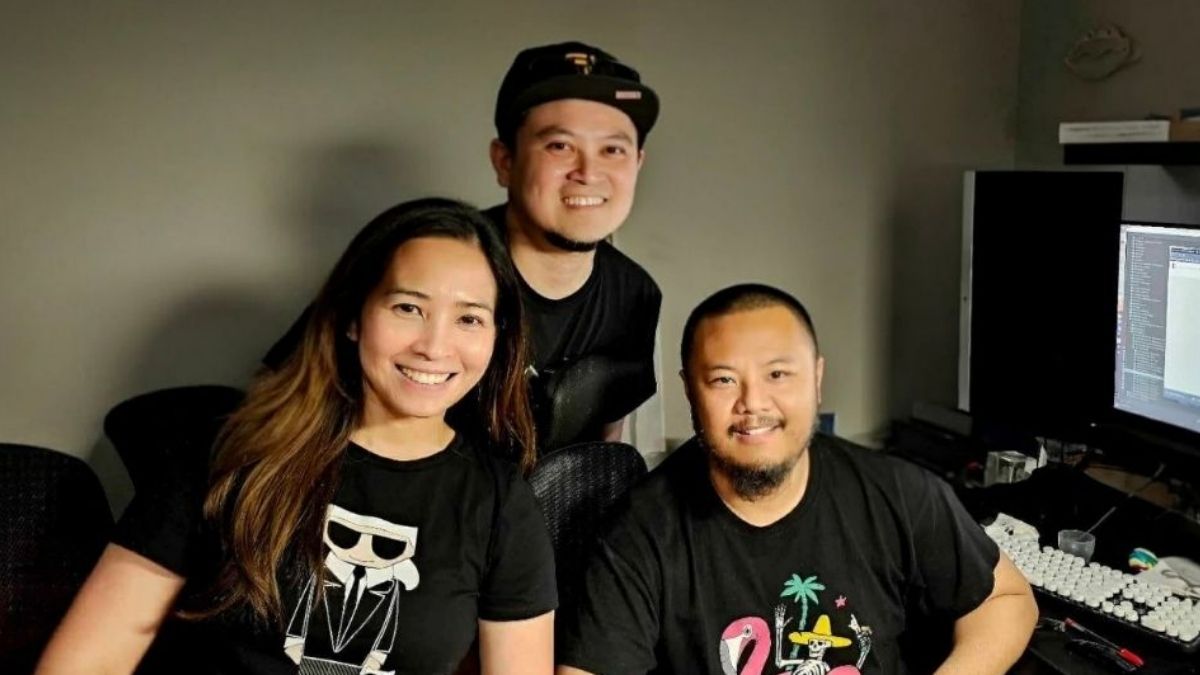
That lane sits at the heart of Likha Music International, founded in 2019 by Ralph Wilson Buado, Karen Abasolo-Buado, and Dennis Del Corro.
Read: Ten Years, One Night: DAY6 lights up Manila at The Decade concert
Speaking with PEP.ph on January 17, 2026, Ralph and Dennis frame sync licensing as a system Filipino artists have long been shut out of—less because of talent, and more because no one ever bothered to explain how the door actually works.
Ralph, a writer, producer, and editor with more than two decades of experience in Hollywood marketing for companies like Disney and CBS, traces the idea for Likha to a frustration he repeatedly runs into at work.
“For fun, I search ‘Filipino music’ in the databases we use for marketing,” Ralph recalls.
“And all those years, I don’t find anything good enough. Either it doesn’t exist, or it sounds like a cheap imitation of popular music in the Philippines.”
The contradiction becomes harder to ignore as Filipino representation on screen continues to grow.
“We have a lot of Filipino characters in U.S. media,” Ralph points out.
“Filipino fighters, martial artists, boxers—but the music isn’t Filipino. That’s the moment I realize this is something we can actually solve.”
That realization sits with him for nearly 15 years.
In 2019, through his wife Karen, Ralph connects with Dennis, a former musician turned lab scientist whose professional life revolves around precision, systems, and structure.
Dennis and Karen were childhood friends who grew up at Teacher’s Bliss in Pasay City.
“He’s very systems-oriented,” Ralph notes about Dennis.
“I’m creative. That balance is exactly what this kind of company needs.”
WHAT SYNC LICENSING ACTUALLY MEANS
Sync licensing feels intimidating at first glance, mainly because it is rarely explained to artists in plain, practical terms—and almost never framed as something meant for them.
“‘Sync’ is short for synchronization,” Ralph breaks down.
“It’s the music playing behind any video—TV shows, movies, trailers, commercials, video games. Licensing just means giving permission to use your song.”
Likha operates by selling sync licenses to studios, networks, and agencies that need production-ready music without paying top-tier mainstream rates.
This means an artist’s income stream doesn’t end when the release cycle does, as a song can keep earning every time it’s licensed into a new project.
A single placement can generate upfront licensing fees, backend royalties, and long-term exposure—often without the artist having to tour, trend, or constantly feed the algorithm.
For independent musicians, sync can grow from being a side hustle to more of a sustainable revenue channel.
Read: 2026 Grammys: Bad Bunny, Billie Eilish, Kendrick Lamar score big wins
Rethinking how artists earn from music
Ralph is blunt about where the disconnect usually happens.
“When I talk to Filipino musicians, they tell me, ‘This is how you make money—selling beats, performing, Spotify,’” he observes. “They don’t realize there’s another model.”
Likha’s model centers on licensing, not ownership.
Ralph furthers: “We’re selling permission to use your music. We’re not selling ownership. You own your music forever. Pass it on to your grandkids. Let them collect the royalties.”
That reframing turns music into a long-term asset instead of a one-off release.
“In sync, you don’t have to be the top one percent. You could be a 60-year-old rapper in your bedroom. A 40-year-old singer making music after work. They don’t care. The music is built for scenes.”
He drives the point home: “The music in sync is not made for the artist. It's not made for the artist and for their fans; it's made for scenes, it's made for a show, it's made for a certain emotion.”
“Don't get it wrong though,” Dennis interjects.
“A lot of musicians that you know today started with Sync. When they started, they were only priced this much and then now that they're so big, you know, they're so, so expensive.”
We zero in on Australian singer-songwriter Sia, known for maintaining anonymity by wearing oversized wigs to cover her face during performances and in public.

Before shooting to stardom for hits like “Chandelier,” “Cheap Thrills,” and “Titanium,” Ralph has worked with her for the 2013 sci-fi mystery drama Under the Dome, loosely based on Stephen King's 2009 novel of the same name.
Ralph says about Sia: "She was in a band called Zero 7, and I’ve always been a big fan, and I’ll always be like, 'How am I gonna use this music? How am I gonna use her?'
“She’s unknown when the show starts. The show becomes a hit, and her popularity follows.”
He later pitches early material from Billie Eilish, years before her global breakout.
“A small amount in few days to five figures a day for sync licensing,” Ralph says.
“That’s the kind of money that a lot of Filipino musicians don’t understand.”
Read: Kim Seon Ho camp refutes alleged tax evasion amid Cha Eun Woo controversy
HOW ARTISTS GET INTO LIKHA
There’s no single pipeline into the roster. Sometimes Likha reaches out. Other times, artists knock.
Ralph answers, “Both. It depends.”
He admits he enjoys the hunt.
“I like searching for them because for me, it’s like going through a crate of records and finding this unknown record that only Dennis knows,” he shares.
Referrals, however, carry weight.
“If they’re referrals, it just means they’re already accepted,” Ralph says.
“But if they come to us, it’s a lot harder because I need them to prove themselves.”
Dennis steps in to explain why that gatekeeping exists.
“If you’re an indie artist and you want to pitch your music to clients, it’s very hard because you’re competing with thousands of musicians. That’s why there are labels like Likha,” he says.
Referrals change the math.
“If you know somebody and they get referred to Likha, you’re pretty much in front of the line,” Dennis explains.
“So, you’re not competing with anybody else.”
Ralph clarifies that what “front of the line” actually means is logistics-wise.
“I’m a writer-editor. So, the music that Likha makes, I could literally just plug it into one of my projects, into one of my trailers.”
The same applies to his professional network.
“I’m literally giving it to my coworkers, to my colleagues of the last 25 years,” he explains. “My editor friends are importing their music into their projects.”
Dennis underlines the advantage: “It doesn’t get lost in the pool of thousands of music. Literally millions.”
When it comes to reviewing submissions from newcomers, they practice a tried and tested formula.
“I don’t even have to listen to it yet. I’m just looking at the waveforms,” Ralph explains.
Flat waveforms are an instant red flag.
Ralph says: “If it’s all flat line at the top, I can tell it’s a bad mix. That’s a bad first impression.
"If I don’t see enough gaps between verses, I need those edit points
“We have to consider the editors and creative directors who are looking for certain elements to work in their show.”
Dennis backs this up with a more technical lens.
“There’s a formula that we look at the waveform. If it’s a horror scene, there’s silence, then it slowly builds up, and there’s a climax,” he says.
Read: Direk Joel at Direk Joey, nangangamba sa AI at vertical shorts
Submitting AI is an automatic rejection
Artificial Intelligence comes up repeatedly in the conversation, and both founders are clear about where Likha stands.
“We don’t work with AI,” Ralph says plainly. “It’s just not accepted by our clients.”
Dennis acknowledges that AI is unavoidable, but draws a firm boundary around its role in music-making.
“AI, we can’t help it. It’s gonna be there,” Dennis says.
“We don’t have a choice. It’s very fast-paced. Literally every day, there’s a new tool that comes out.”
Still, he points out that the music industry has not embraced AI-generated work in the same way other fields have.
“In music, it’s not very well received,” Dennis adds. “There’s such a thing as authenticity. There’s still a need for human touch.”
For Dennis, AI functions as support, not creation.
“AI is gonna be there just as a tool,” he explains. “For assistance. Like an admin part, or a database. But making music, you can really tell that it’s not a human being that made it.”
Ralph echoes this distinction, comparing AI to earlier tools that enhanced production without replacing the artist.
“For some people, it’s like how they see Auto-Tune. It can enhance vocals.”
But when AI crosses into full content generation, problems begin.
“Generating new content, new media, new music—it’s not accepted by our clients,” Ralph affirms.
“The market doesn’t demand it. Our market is our clients. We’re selling licenses.”
He also raises a fundamental issue artists rarely consider: ownership.
“Music is trained on other people’s music. So how do you put value on that? How do you charge someone?”
From a licensing standpoint, the risks are immediate.
“A client can just say, ‘You don’t own the copyright. I’ll just cover it. Problem solved.”
Dennis adds another concern from an artist’s perspective.
“If you start out writing with AI,” he says, “how do you perform live? How do you give the experience to your fans?”
Both founders agree that AI can be useful when treated as a creative aid, not a replacement.
“AI can help you write quicker,” Ralph says. “It can help you brainstorm ideas a lot quicker.”
But he draws a final line.
“The weakest creatives get replaced. The ones who see it as a tool and use it to their advantage—that’s where it works.”
Read: Vic Sotto and Pauleen Luna celebrate 10th anniversary with vow renewal