
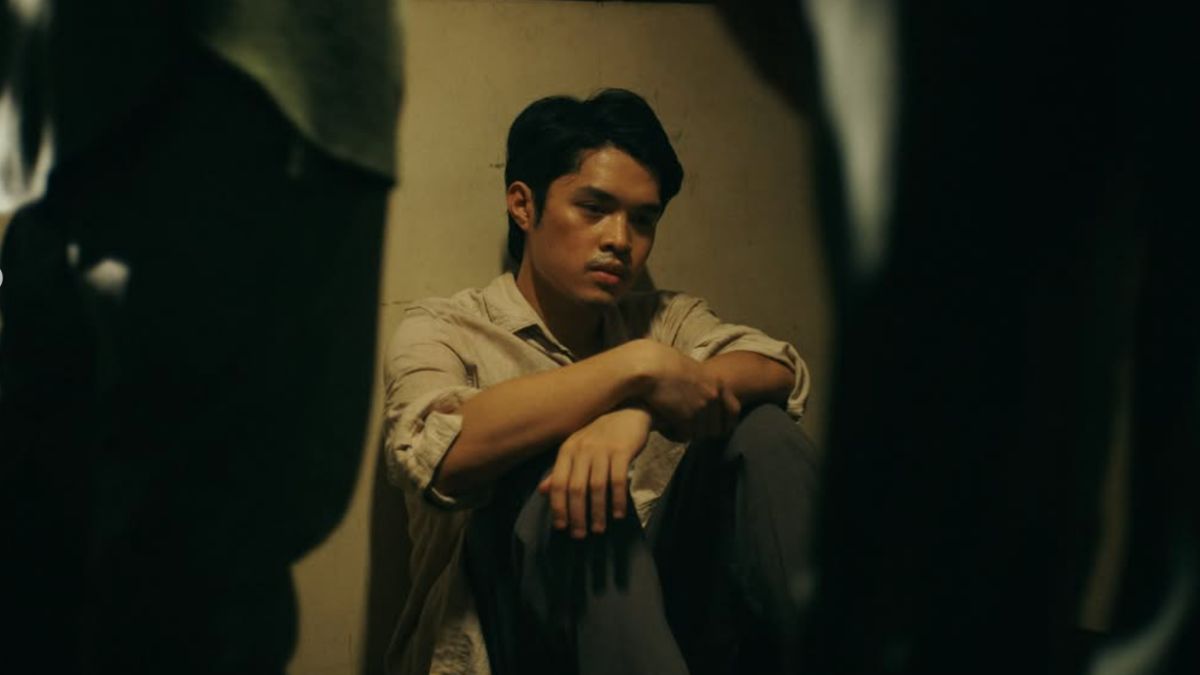

For Elijah Canlas, playing Edgar Jopson isn't just another role.
The award-winning actor has long admired the labor activist, a connection rooted deeply in his own upbringing and perspective on art.
“Lumaki ako bilang iskolar at lumaki ako na aware ako sa kapangyarihan ng craft ko, sa kapangyarihan ng sining,” Elijah told PEP.ph (Philippine Entertainment Portal) in a recent interview.
“Lagi't lagi ang sining para sa bayan. Lagi't lagi para sa pagmamahal, para sa pamilya. And sobrang nag-align sa sa akin yun with EDJOP, lahat ng iyon.”
So when he was offered to play the young version of the activist, he knew he had to convince director Katski Flores to let him take on the full role.
Undergoing additional auditions and screen tests, he fought for the opportunity to portray the character through through the height of his revolutionary struggle. This conviction pays off.
Elijah’s belief in the power of art translates into an immediate gravitas the moment he appears on screen. By channeling his own ideals into the performance, he brings a commanding presence that makes the activist's rapid evolution feel both urgent and deeply human.
Read: REVIEW: Forgotten Island is a window into a Philippines we know by heart
THE PLOT
EDJOP serves as a biographical account of the renowned activist, but its narrative ambitions extend far beyond a standard historical retelling.

The film actively interrogates the aftermath of martyrdom, posing difficult, uncomfortable questions about whether Edjop’s ultimate sacrifice still holds weight in the present day.
Rather than simply memorializing his actions during the martial law era, the script forces an examination of what that legacy actually left behind for the country—and more specifically, for the family that survived him.
This thematic tension is explored through the modern-day perspective of Joyette, played convincingly by Jodi Sta. Maria.
As Edjop's daughter, Joyette anchors the film's contemporary timeline, providing a lens through which the audience views the historical flashbacks.
She is not portrayed as a willing heir to a revolution, but rather as a woman struggling with her own complex political quandaries.
Her character represents the collateral damage of political martyrdom, forced to reconcile a parent's national heroism with their personal absence.
The film visualizes this internal conflict by characterizing Joyette as a runner, both in a literal and figurative sense.
Pounding the pavement serves as her primary coping mechanism, a physical manifestation of her constant need to flee from her deeply rooted problems.
For Joyette, avoiding politics is an act of self-preservation.
She actively resists being defined by the heavy, complicated legacy of her father, running away from the very cause that claimed his life in an attempt to carve out an identity untethered to the past.
Read: REVIEW: Muli hits all the right notes and packs a punch of ‘90s nostalgia
THE DIRECTION
Balancing Edjop and Joyette’s stories is a considerable structural challenge, but director Katski Flores deftly handles the dual narratives.
The film frequently moves back and forth in time, shifting between Edjop’s past and Joyette’s present, yet remains easy to follow.
Flores directs with a tight, controlled vision, allowing the past and present to seamlessly bleed into one another.
Aided by Jade Castro’s precise script and Neil Daza’s visually distinct cinematography, the time jumps feel organic rather than disorienting.
The success of this ambitious structure relies heavily on Elijah maintaining continuity.
Despite the staggered three-year shooting schedule, he seamlessly navigates the distinct stages of Edjop’s life, shifting convincingly from a bright high school student to an idealistic college leader, and finally to an underground revolutionary during martial law.
The emotional weight of these parallel eras is carried by a formidable supporting cast. The ever-reliable Jodi Sta. Maria grounds the modern timeline with a highly nuanced performance.

On paper, Joyette’s active avoidance of politics and apparent betrayal of her father's revolutionary legacy could easily teeter into viewer frustration or disgust.
Yet, Jodi infuses the character with warmth and vulnerability that make her desire to escape the past deeply relatable rather than alienating.
In the historical timeline, Kakie Pangilinan delivers a breakout turn in her major acting debut as Young Joy, Edjop’s girlfriend, and eventual wife.

She shines as the emotional anchor of the past, bringing a deeply understanding and big-hearted presence that humanizes the intense political struggle surrounding her.
The character's evolution is then seamlessly carried into the present by Menchu Lauchengco-Yulo, who portrays the older Joy with an enduring grace.
Menchu provides a quiet, resilient strength that resonates beautifully throughout the film's contemporary sequences.
THE HICCUP
The film loses some of its momentum in the final act. As the narrative focus shifts heavily toward Joyette's modern-day realizations, the ending drags.
The script guides her through the same emotional epiphanies repeatedly, causing the conclusion to feel quite overwrought and preachy.
Cutting much of this repetitive introspection would have resulted in a sharper resolution.
Ultimately, even with an unraveling third act, the film remains a solid biographical film.
It is still showing in cinemas.