


As we age, we find it harder to lose weight.
Even if we exercise, watch what we eat, and work out, the pounds don’t shed the way they used to.
This can result in frustration and affect our self- esteem.
Add to that the comments of other people who are quick to judge and say that the reason we’re not losing weight is simply that we lack self-control and discipline.
Board-certified endocrinologist Dr. Erick Mendoza smashes that notion.
During his talk at the launch of Marie France’s Go Lose Pounds Program held on September 26, 2026, at the Manila Peninsula, Dr. Mendoza expounds on the different reasons why losing weight is not as easy as hitting the gym or going on a diet.
He says there is a need to look beyond the numbers we see on the scale.
“There should be a holistic approach to body composition, strength, and health. So hindi lang po dapat nakapako sa numero ang ating mga mata, kundi sa overall health.”
Dr. Mendoza goes on to explain: “People will tell you: you eat less, you exercise more. You try harder.
"And then when you fail, di ba, it seems that they make you feel that you failed when the weight comes back? So you feel a certain shame or inadequacy. And that's not right.
“Hindi na po tama iyan ngayon sa panahon na ito, because obesity is multifactorial.”
Internal Factors Contributing to Weight Gain
“Weight gain is not simply a failure of willpower,” Dr. Mendoza says.
Many factors like biology, genetics, and medical conditions can predispose patients to weight gain.
“So we have hormones and neurotransmitters. Meron na po ngayong leptin resistance. Dati insulin resistance lang, but now we have leptin resistance, which promotes weight gain.”
Leptin resistance, according to Cleveland Clinic, happens when the brain stops responding normally to leptin.
Leptin is a hormone released by adipose tissue or body fat that helps the body regulate and maintain its weight over the long term.
It helps prevent hunger and gives the feeling of satiety or feeling full. When there is leptin resistance, you don’t feel satiated, causing you to eat more.
Having leptin resistance can also lower your Basal Metabolic Rate (BMR), because the seeming lack of leptin results in your body entering starvation mode.
This is when the brain decreases energy levels and makes the body use fewer calories at rest.
Leptin resistance worsens weight gain by making you feel hungry and lowering your BMR.
too much stress and LACK OF SLEEP
Dr. Mendoza also mentions that lack of sleep and stress can bring about inflammation.
An article published by Harvard Health discusses research that found “sleep deprivation is associated with markers of inflammation, such as increases in inflammatory molecules - including cytokines, interleukin-6, C-reactive protein (CRP), and others.”
CRP is a marker of inflammation that's elevated in people at risk for heart disease and diabetes.
Meanwhile, a 2017 study notes that “intense stress over-activates the immune system, leading to the imbalance between inflammation and anti-inflammation.”
When the stress pathways are activated, it can initiate or aggravate inflammation.
Aside from these, Dr. Mendoza says patients taking anti-anxiety medications and antidepressants can also have an increased appetite and in turn gain weight.
In addition, medical conditions such as hypothyroidism and metabolic syndrome can also make you predisposed to weight gain.
External Factors Affecting Weight
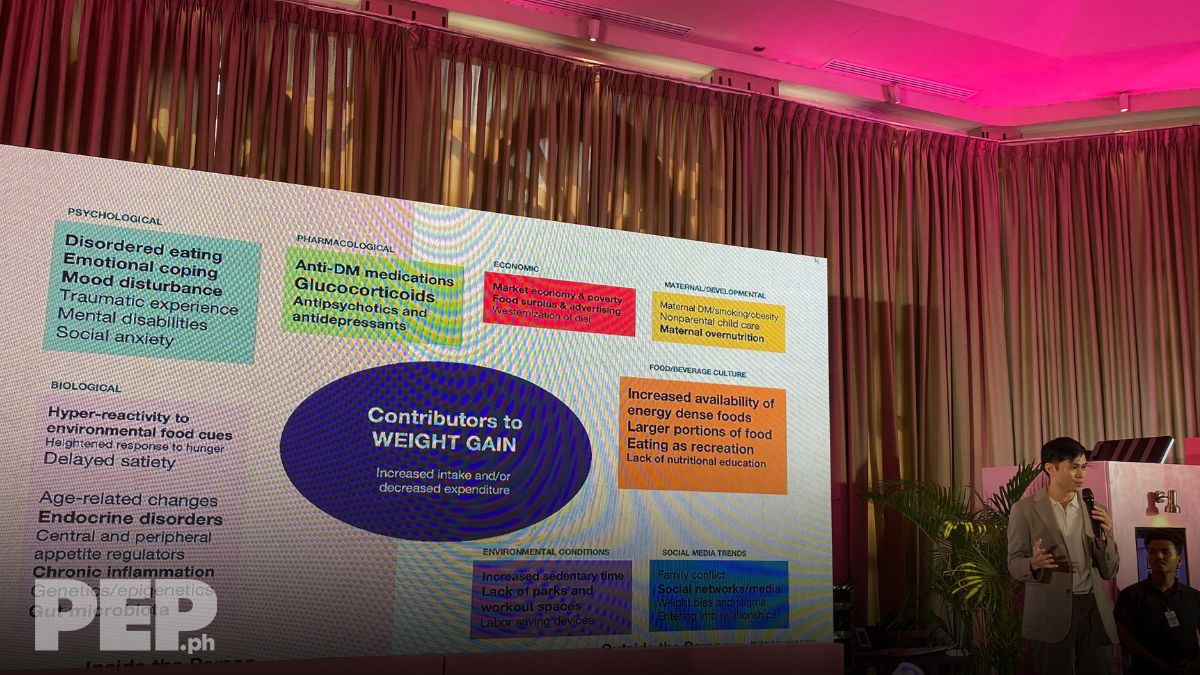
“When looking at obesity, we look inside the person. But we need to look also outside the person,” Dr. Mendoza continues.
“There are economic factors, things that begin in the gestation or in the childhood, food and beverage culture, environmental conditions like lack of parks and workout spaces, and also social media trends.”
All these external factors can affect a person’s weight gain.
Read: Judy Ann Santos gives daughter Yohan’s new hairstyle a thumbs-up
Approaching Weight Loss the Right Way
With these information in hand, Dr. Mendoza calls for a change in mentality.
“You are not lazy, you are not weak, and certainly you are not a failure."
It’s not entirely your fault, so stop blaming yourself.
“Because your body changes. And with these changes, we have to consider aging and metabolism.
"We cannot have a full control of those things, but there are things we can control, such as lifestyle and choices so that it will fit the body composition that we want.”
While some factors cannot be changed, the endocrinologist says we are not powerless.
Now that we understand obesity better as multifactorial, there are also different solutions to address the problem.
In this vein, Dr. Mendoza reminds that every body is different, and there is no one-size- fits-all approach.

Go Lose Pounds (GLP) Program of Marie France
This is where the Go Lose Pounds (GLP) Program of Marie France comes in.
“We need an integrated, professional, and multidisciplinary approach that an institution like Marie France can deliver.
“What works for others may not work for you and vice versa. Your body deserves a personalized plan, and there's no single diet, no single exercise program, and more importantly, no single medication that is right for everyone. So it should be individualized.”
In the Go Lose Pounds Program, Marie France looks into the client’s medical history, eating patterns, activity, sleep, emotions, medications, laboratory results, and body composition.
A team of doctors, nutritionists, and consultants work together to provide a plan of approach.
This may or may not include the medication GLP-1 agonists. GLP-1 stands for glucagon-like peptide-1, a hormone produced by the body.
According to Stanford Medicine, GLP-1 lets all the organs know that you’re full and have a stomach of food ready to be used.
Dr. Dan Azagury, medical director of Stanford’s Lifestyle and Weight Management Center, says GLP-1 is like “a food thermostat in your gut. It detects what you’ve just eaten and tells your body to do the things it needs to do to digest and process those calories.”
GLP-1 agonists are drugs that mimic this hormone, boosting your body’s feeling of being full.
For Dr. Mendoza, who is an assistant professor in medicine and holds an MBA in healthcare, GLP-1 agonists helped revolutionize weight management.
For eligible and properly assessed patients, they helped in reducing cravings, achieving fullness, and achieving weight goals.
It also helped improve the health conditions of those with diabetes, sleep apnea, osteoarthritis, and diseases of the heart, liver, and kidney.
He underscores: “The efficacy of GLP-1 proved that obesity is a biologically-regulated disease that responds to therapy. So aside from being effective, ano pa yung na-prove ng GLP-1?
"Na wala pala dapat stigma, kasi nag-respond yung patient sa gamot.
"Ibig sabihin it is a true disease. Hindi siya parang, ‘Ay ano lang iyan, tamad lang’ or ‘No willpower.’ So that is another triumph of introducing GLP-1 to the medical community and to the public.”
While the medication has worked on a lot of people, Dr. Mendoza cautions: “It's not something that pwede siyang i-DIY of anyone. There should be proper assessment and proper conversation with professionals.”
Read: Niña Jose addresses concerns over her appearance, weight loss