

Eat Bulaga! has undoubtedly earned its place in Pinoy pop culture, having been around since 1979.
While main hosts Tito Sotto, Vic Sotto, and Joey de Leon, or TVJ, served as the show's faces, the program benefitted tremendously from its many segments that left viewers, young and old, glued in front of their TV sets.
These segments, aside from being innovative, were trailblazers as well, serving as a blueprint for contests that we commonly see on TV today.
And with Eat Bulaga! currently in turmoil and in a transition phase, its influence as the country's longest-running noontime show is being dissected anew, with many reminiscing about its impact on Philippine television and entertainment as a whole.
PEP.ph (Philippine Entertainment Portal) takes a look at some of the show's most memorable segments that contributed to the show's success and longevity.
"Bulagaan"
Eat Bulaga! gave the popular “knock-knock” jest a unique spin by requiring its hosts to incorporate the jokes into a song.
To make it more fun, the hosts were divided into groups with school uniforms as get-up and a classroom as a setting.
Reminiscent of a class recitation, group members answered the questions by inserting their answers into songs for added challenge.
A giant roulette wheel determined the score, ranging from 00 to 100.
The winning groups would punish the group with the lowest score by throwing cream pies at them and the studio audience at the end of the program.

"Little Miss Philippines"
First introduced in 1984, "Little Miss Philippines" became one of the show’s most popular and signature segments.
Cute and talented kids took center stage for a chance to take home the title of "Little Miss Philippines" after weeks of competition.
But more than the crown, the segment became the gateway for many eventual child stars and future celebrities, winner or not.
Some of the celebrity graduates of "Little Miss Philippines" were Jessa Zaragoza, Gladys Reyes, Camille Prats, Pauleen Luna, Lady Lee, Kim Domingo, Francine Prieto, Jillian Ward, Julie Anne San Jose, Ryzza Mae Dizon, and Aiza Seguerra, now known as Ice Seguerra.
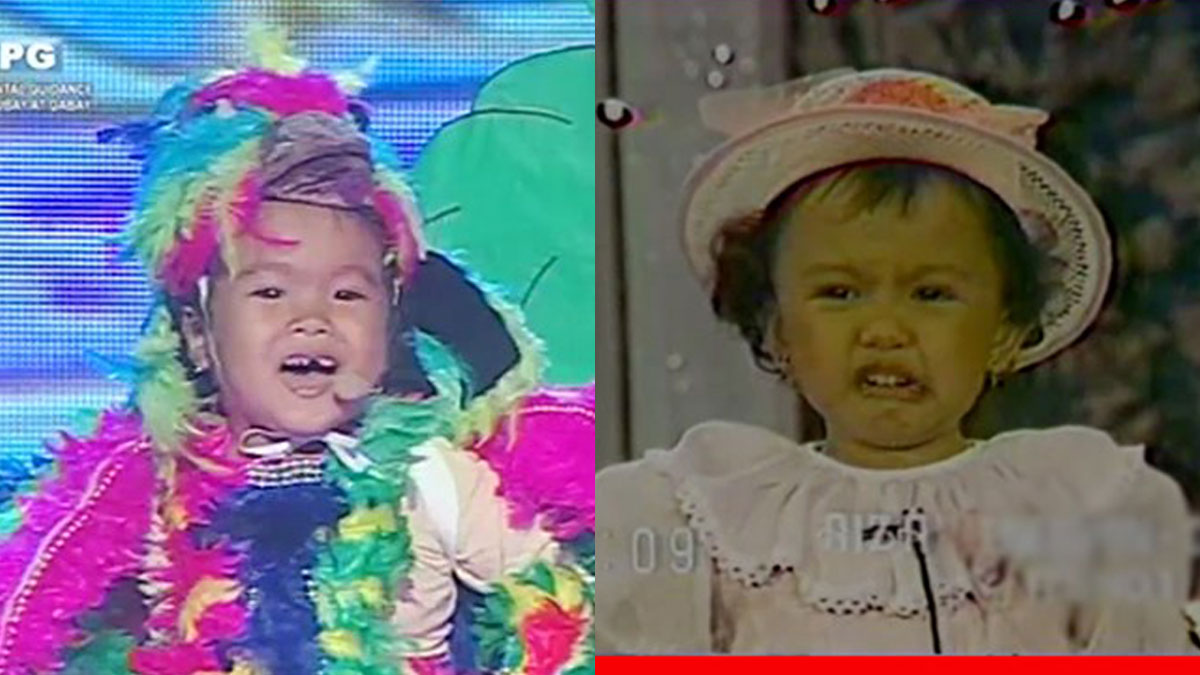
Ryzza Mae Dizon (left) and Aiza Seguerra (right)
"Mr. Pogi"
Dashing young men were given time in the spotlight to flex their looks, talents, and smarts on national TV.
Since its inception in 1987, "Mr. Pogi" earned its place among Eat Bulaga!’s most loved and memorable segments.
Likewise, the segment jumpstarted the showbiz careers of some of its participants, with actor Jericho Rosales among its notable alumni.
Kapuso actor Edgar Allan Guzman also got his showbiz headstart courtesy of the segment.

"Doble Cara"
Alternating between male and female voices when singing is a rare, exceptional gift.
The team behind Eat Bulaga! knew this and thus came up with a segment designed to cater to these talented yet unheralded individuals.
For added stage drama, the contestants wore male attire on one side and female get-up on the other to match the kind of voice used during the performance.
The early versions of the segment saw the contestants lip-syncing or singing using pre-recorded vocal tracks.
Later iterations, however, required contestants to sing live, turning the segment into an actual singing competition.

LENTEN SPECIAL
In keeping with the solemnity of Holy Week, Eat Bulaga! would halt regular programming and instead air drama specials that featured the Eat Bulaga! hosts and guest actors.
These Lenten specials were stories about life and held moral lessons at the end.
Eat Bulaga! stopped producing Lenten specials in 2009 before reintroducing them in 2014, with drama specials inspired by the life stories of the winners of "Juan for All, All for Juan: Bayanihan of d' Pipol."

"BEAUTIFUL GIRL"
Before beauty pageants on TV shows became the norm, there was Eat Bulaga! and its "Beautiful Girl" segment.
The segment, inspired by Jose Mari Chan's hit single "Beautiful Girl," debuted in 1990 and made comebacks in 1992, 1993, 1998, and 1999.

Jennifer Umali, "Beautiful Girl" 1990 winner
"LABAN O BAWI"
Eat Bulaga! upped the ante in terms of giving out cash prizes through the contest "Laban O Bawi."
Here, game contestants arranged the boxes for a chance to clinch the jackpot prize amounting to as high as one million pesos.
Contestants needed to survive the elimination round first before moving on to the jackpot round.
Adding color to the game was the presence of the show's then-resident dancers, the SexBomb Girls.
Speaking of which, the SexBomb Girls, with their sexy outfits and dance moves featured prominently in the segment, gained the ire of moralists who saw their antics unfit for noontime viewing.
However, this failed to sway viewers away from enjoying the segment as the SexBomb Girls were at the height of their popularity at the time.
Who would forget the dance group's memorable line, "Laban, Laban, o Bawi Bawi. Get! Get! Awww!"

SexBomb Girls
"That's My Boy"
Taking a page from the show's old segment titled "Little Mr. Pogi" was "That's My Boy" — a contest geared towards talented and charming male kids.
"That's My Boy" was the male version of the noontime show's popular "Little Miss Philippines."
Like the latter, "That's My Boy" introduced a couple of new child stars in Philippine showbiz, including BJ Forbes, who nabbed a stint in Eat Bulaga! because of the segment.

"Gaya Gaya, Puto Maya"
Eat Bulaga! took the Filipino street phrase "gaya, gaya, puto maya" and brought it to national television in the 1980s and in succeeding years.
"Gaya Gaya, Puto Maya" saw contestants lip-synching to the singing voice of a celebrity being impersonated.
Whoever got to best imitate the look and actions of a foreign or local personality won the contest.
Modern viewers might remember the Philippine version of the singing and interpretation competition Your Face Sounds Familiar, which first aired on ABS-CBN in 2015, as having the same format. This makes "Gaya Gaya, Puto Maya" the precursor to such a concept.

Vic Sotto (left) and Paolo Ballesteros (right)
"SUPER SIREYNA"
Eat Bulaga! put the spotlight on trans women through the segment "Super Sireyna," launched in 1995.
The concept alone was novel given that a contest dedicated to transgender women was unheard of at the time.
Today, this concept is common in local television, with It's Showtime's "Miss Q&A" coming to mind.

"Maid in the Philippines"
A beauty pageant for domestic helpers? Eat Bulaga! did just that in 1982 when it launched "Maid in the Philippines."
The segment gave domestic helpers a platform to showcase their talents and smarts, shattering unfair stereotypes associated with the profession.
Needless to say, the segment was a hit for domestic helpers living here in the country and abroad.

May Rivera, "Maid In The Philippines" 2002 winner
"Juan for All, All for Juan: Bayanihan of d'Pipol"
The country's longest noontime show took their acts to the streets and masses.
Eat Bulaga! co-hosts went to the barangays across the Philippines to interact with people on the ground and hand out financial help.
But more than the money and prizes, the segment touched the hearts of viewers, courtesy of the touching real-life stories of common folks.
Thanks to its popularity, the segment also spawned several subsegments that equally delighted Eat Bulaga! viewers.

"Kalyeserye"
Speaking of successful "Juan For All, All For Juan: Bayanihan of D'Pipol" subsegments, none was bigger than the soap opera-ish "Kalyeserye."
The subsegment gave birth to the accidental and phenomenal love team of Maine Mendoza (then popularly known as Yaya Dub) and Alden Richards.
The pair thrilled viewers with their interactions, as they communicated by lip-syncing to pop tunes and audio clips lifted from films.
Fans dubbed Maine and Alden's pairing AlDub, and their onscreen partnership boosted Eat Bulaga!'s popularity and ratings further, extending all the way to social media and the Internet.
Eat Bulaga!'s ratings hovered above 40 percent, and culminated in a jaw-dropping 50.8 percent on October 24, 2015, during the AlDub Grand Fans Day held live at the Philippine Arena.
The episode earned at least 39.5 million tweets for the hashtag #ALDubEBTamangPanahon in 2015.
Interestingly, it broke the record of the hashtag #WorldCup match between Germany and Brazil in 2014.
Read: RATINGS THROWBACK: Record-breaking TV ratings of Eat Bulaga! during the AlDub craze
"Kalyeserye" ran from 2015 to 2016, but its impact continues to be felt to this day by both Maine and Alden, and Eat Bulaga!.

Alden Richards and Maine Mendoza
"Bawal Judgmental"
Debuting on October 29, 2019, "Bawal Judgmental" required players to examine and guess the correct life choices of a group of people.
In the process, emotional experiences from the past were brought to light, triggering reactions of awe and surprise from studio and TV viewers.
The segment became a venue for societal issues and current issues to be discussed on national television.
"Bawal Judgmental" had also become a platform for celebrities to clear past and present issues, while some revealed fun, interesting trivia about their life and career that were unknown to the public.
Read: Cogie Domingo, nilinaw na hindi tinatalikuran ang pag-arte
Read: Alice Dixson pangarap maging astronaut ang kanyang baby girl na si Aura

"Pinoy Henyo"
Memorable and now iconic, "Pinoy Henyo" saw contestants playing a guessing game under time pressure.
The format went like this: a piece of paper with a word written on it was placed on the forehead of a contestant.
The contestant would have to guess the word by firing questions at his partner and co-contestant, who was prohibited from giving away too much information and could only reply "Oo," "Hindi," or "Puwede" to help the guesser.
Read: Eat Bulaga's "Pinoy Henyo" contestants break silence on cheating issue
Read: Dabarkads, may patutsada sa Pinoy Henyo contestants na nandaya sa game
The team who guessed the correct word in less time would move on to the jackpot round.
"Pinoy Henyo" hit the right spots among viewers, so much that parties and gatherings hosted by Filipinos here and abroad often include the game for fun and laughs. It even became dubbed as the "pambansang laro ng bayan."