



Electricity bills have become one of the biggest concerns among Filipino households in recent months, especially after many consumers noticed a sharp increase in their monthly charges.
The issue even became a hot topic on social media, with several personalities publicly sharing their Meralco bills, and, questioning why the amount had suddenly gone up despite claiming that their electricity consumption had not significantly changed.
A Meralco bill is made up of several charges, and each one serves a different purpose.
Some charges pay for the electricity itself, while others cover the cost of delivering power to homes and businesses.
While Meralco delivers electricity to homes and businesses, not every peso on the bill actually goes to the company.
There are even government-mandated charges that distributors are required to collect.
To help consumers better understand where their money goes every month, PEP.ph (Philippine Entertainment Portal) sat down exclusively with Meralco Assistant Vice President and the Head of Home and Microbiz for the North Business Area Alleni O. Pascual.
She explained the different components of a Meralco bill, what causes electricity rates to increase, and the misconceptions that continue to confuse many customers.
Here's a closer look at how a Meralco bill works.
Read: Barbie Imperial shocked by nearly PHP19K Meralco bill
Why are electricity bills higher?
Many consumers assume that a higher electricity bill automatically means they used more electricity.
However, according to Pascual, that's only part of the story.
She said the recent increase in electricity bills has been driven largely by higher generation charges, which have been affected by several external factors beyond consumers' control.
"Mga recent months natin na pagtaas ng bills, mostly because of higher generation charges. So ito, driven by higher fuel cost as well as yung weaker peso," Pascual explained.
"Even without pagbabago sa household habits or usage, yung external pressures na ito, these push the generation charge upward."
She added that electricity bills are influenced not only by how much electricity households consume, but also by how much it costs to purchase electricity in the first place.
Among the biggest factors are rising global fuel prices, a weaker Philippine peso, and fluctuations in electricity prices in the Wholesale Electricity Spot Market (WESM), where electricity is traded between power producers and buyers such as Meralco.
Pascual noted that periods of tight power supply can also push electricity prices higher.
"Kapag merong tight supply tapos we have higher demand, that also pushes si Wholesale Electricity Spot Market prices. Kasi in WESM, that is where we buy our supply. That's where electricity is being traded as a commodity.
"Kapag merong tight supply... that also affects the supply and demand balance, affecting the cost."
Read: Cacai Mitra questions PHP94K electric bill; Meralco responds
Understanding WESM
One of the biggest factors behind recent electricity rate increases is the Wholesale Electricity Spot Market (WESM).
In simple terms, WESM is the country's trading market for electricity, where power producers sell electricity and distribution utilities such as Meralco buy additional supply whenever needed.
Pascual likened it to a marketplace where electricity is treated as a commodity, with prices changing depending on supply and demand.
"Actually, si Wholesale Electricity Spot Market is essentially a stock market for electricity in the Philippines," she explained.
"WESM allows power producers, as well as distributors like Meralco, to trade electricity similar sa ibang market na parang electricity is treated as a commodity."
Like most markets, electricity prices in WESM fluctuate.
When there is enough electricity supply to meet demand, prices tend to remain stable. But when power supply becomes tight while demand remains high, electricity becomes more expensive.
Pascual stated: "Kapag merong tight supply tapos we have higher demand, that also pushes si Wholesale Electricity Spot Market prices.
"Kapag merong tight supply... that also affects the supply and demand balance, affecting the cost."
According to her, this happened during the Luzon Red Alerts in June 2026, when WESM prices climbed to more than P7 per kilowatt-hour.
"Si WESM prices hit over PHP7 per kilowatt-hour during the Luzon Red Alerts," she said.
"That contributed to close to 30 centavos per kilowatt-hour increase in the generation charges, adding about PHP30 to a typical household bill."
Read: ASK MERALCO: How everyday use of appliances affects monthly bill
GENERATION CHARGE: THE BIGGEST CHARGE ON THE BILL
The generation charge is the largest component of every Meralco bill, accounting for about 64 percent of the total amount consumers pay each month.
According to Pascual, this charge represents the actual cost of purchasing electricity from power generation companies, as well as from the WESM whenever additional supply is needed.
"The generation charge is the actual cost of power bought from generation power companies. So these are the power plants; and then we also have the Wholesale Electricity Spot Market where we source some of our supply."
She stressed that Meralco does not generate electricity itself. Instead, it purchases electricity from suppliers before delivering it to homes and businesses.
"Let's think of Meralco as a delivery company, so not the power producer. We pass on the cost of power itself, and we don't mark it up."
Pascual added that the company simply charges customers based on the actual cost of the electricity it purchased.
"So this is how much we bought the power, the supply, the electricity, and this is what we collect based on how much we have actually acquired the supply."
She also emphasized that the generation charge is not determined solely by Meralco.
"This is actually regulated by the Energy Regulatory Commission," Pascual said, noting that the rates undergo regulatory review before they are reflected in consumers' electricity bills.
Read: ASK MERALCO: Do on-and-off power, unplugging affect electric bill?
OTHER COMPONENTS OF THE BILL
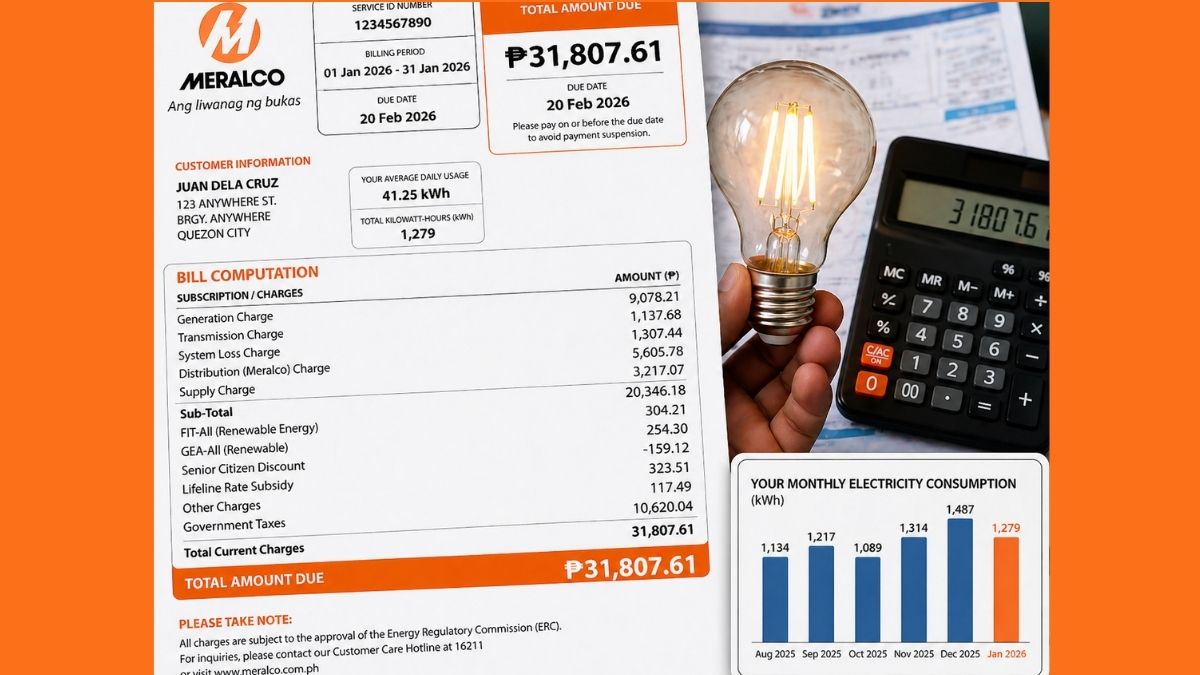
Transmission Charge: Bringing electricity to your home
After electricity is generated by power plants, it still needs to travel across the country's transmission network before it reaches homes and businesses.
This is where the transmission charge comes in.
Pascual explained: "The transmission charge covers the cost of using the power highway. It covers the cost of delivering electricity from power plants to the distribution utilities and electric cooperatives.
"It is also to cover the cost for ensuring the grid stability."
Unlike the generation charge, the transmission charge is not determined by Meralco.
"The rates are set by the National Grid Corporation of the Philippines, the country's sole transmission provider, and also approved by the Energy Regulatory Commission (ERC)."
She also noted that transmission rates are not uniform across the country: "The rates differ across regions. So the rates differ in Luzon, Visayas, and Mindanao since each grid has its own cost structure."
System Loss Charge: Why customers pay for lost electricity
As electricity travels from power plants to consumers, a small portion is inevitably lost before it reaches homes and businesses.
This is reflected in the system loss charge, which covers electricity lost due to technical and non-technical factors during the transmission and distribution process.
According to Pascual, the system loss charge forms part of the generation and transmission costs paid to power generation companies and the National Grid Corporation of the Philippines (NGCP).
"System loss charge is part of the generation and transmission costs paid to power plants and National Grid Corporation of the Philippines. This accounts for electricity loss due to technical and non-technical factors."
However, she clarified that consumers are protected by regulations set by the ERC: "The Energy Regulatory Commission has set a system loss cap, and any losses beyond this limit cannot be passed on to customers."
This means distribution utilities cannot simply charge consumers for unlimited electricity losses, as any amount exceeding the ERC's prescribed cap becomes the utility's responsibility.
Distribution Charge: The portion that goes to Meralco
While many consumers assume their entire electricity bill goes to Meralco, Pascual clarified that only the distribution charge is the portion that pays for the company's actual services.
This covers the operation and maintenance of the distribution network that delivers electricity from the transmission grid to homes and businesses.
"The distribution charge is the portion that covers Meralco's actual service, maintaining the wires, the poles, and the infrastructure that gets power into our homes, plus the billing and metering," Pascual explained.
She said this component, also referred to as the distribution, supply, and metering charge, accounts for only about 12 percent of a customer's total electricity bill.
The remaining 88 percent consists of pass-through charges that Meralco collects on behalf of power suppliers, transmission providers, and the government.
Pascual also stressed that Meralco cannot increase the distribution charge on its own: "Any charge to it needs actually ERC review and approval. So it's not something that Meralco can adjust on its own."
In fact, she noted that Meralco's distribution, supply, and metering charges have remained unchanged for more than 10 years.
"For Meralco, the distribution, supply, and metering charge fees have remained unchanged for over 10 years, and any adjustment to these charges require review and approval of the Energy Regulatory Commission."
Government-mandated charges
Aside from the generation, transmission, system loss, and distribution charges, a Meralco bill also includes several government-mandated charges.
These include taxes, subsidies, and other regulatory fees that distribution utilities are legally required to collect from consumers.
According to Pascual, some of these charges include the Feed-in Tariff Allowance (FIT-All), Generation Rate Adjustment Mechanism (GRAM), Lifeline Subsidy, Value-Added Tax (VAT), local franchise tax, and property tax.
"These are government-mandated charges. For example, sila FIT-All... and then sila Lifeline Subsidy. These are fixed naman per kilowatt-hour."
Pascual added that all charges reflected in a Meralco bill have a legal or regulatory basis.
"All the charges reflected in the bill, these have regulatory basis. So either mandated siya ng government or through the Energy Regulatory Commission rates. Meralco does not collect any charge without a regulatory basis."
UPDATE
At the State of the Nation Address of President Ferdinand Marcos Jr. earlier, July 27, 2026, he called for the removal of the system loss charge passed on to electricity consumers as part of proposed reforms to the EPIRA.
At press time, the charge remains part of consumers’ electricity bills pending any legislative or regulatory changes.
Read: ASK MERALCO: How aircon, inverter, brand affect eletric bill